The population structure and genetic health of European wolves

The population structure and genetic health of European wolves
Todd, E. T.; Fontsere, C.; Sun, X.; Scharff-Olsen, C. H.; Hernandez-Alonso, G.; Lanigan, L. T.; Gomes Martins, N. F.; Ciucani, M. M.; Ramos-Madrigal, J.; Hennelly, L.; Mak, S. S. T.; Andersone-Lilley, Z.; Asberg, A.; Balciauskas, L.; Baltrunaite, L.; Baryshnikov, G. F.; Boldbaatar, B.; Boldgiv, B.; Bolfikova, B. C.; Borowik, T.; Bujnakova, D.; Ciucci, P.; Coban, A. K.; Coban, E.; Erlandsson, M.; Flagstad, O.; Frantz, L.; Geffen, E.; Harmoinen, J.; Jelk, L.; Kalthoff, D. C.; Karamanlidis, A. A.; Kemahlı-Aytekin, M. C.; Kojola, I.; Kopatz, A.; Kosintsev, P.; Kusak, J.; Kuznetsova, A.; Kvist, L.;
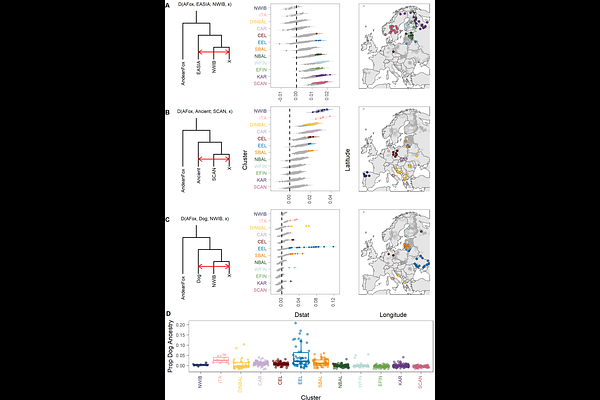
AbstractOnce nearly eradicated from Europe, grey wolves (Canis lupus) have recently undergone a remarkable demographic recovery, but their long-term survival remains precarious. By analyzing 1,001 genomes, we uncover a mosaic of distinct evolutionary lineages, not a single recovering population. Northern populations exhibit Asian wolf ancestry, while southern populations preserve ancient Holocene lineages, with dog introgression varying by region. Isolated wolves from the Scandinavian, Italian, and Iberian peninsulas harbored particularly high levels of inbreeding and fixed deleterious mutations. Signatures of genome erosion were widespread across Europe, with many populations falling well short of the minimum size recommended for long-term survival. Our study reveals the complex tapestry of wolf ancestry and variation across Europe, which calls for nuanced, regional conservation plans founded in genetic monitoring.