Measure Sodium Transport in Cells with NMR

Measure Sodium Transport in Cells with NMR
Xia, J.; Yin, Y.; Chen, Y.; Wu, X.; Li, H.; Liu, Y.; He, Q.; Ji, Y.; Ma, K.; Dai, B.; Bai, H.; Yang, F.; Bai, R.; Kong, X.
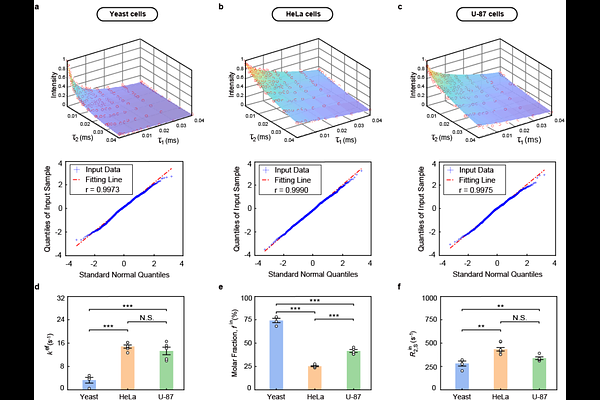
AbstractSodium ions (Na) are fundamental to numerous physiological functions, such as maintaining electrolyte balance, enabling nerve impulse transmission, and facilitating muscle contraction. Dysregulation of Na transport across cell membranes is implicated in a range of health issues, including metabolic syndromes, neurological conditions, and cardiovascular diseases. However, current methods for assessing cellular Na activity often face limitations; they can be invasive or fail to capture dynamic changes. In this study, we introduce a non-invasive 23Na nuclear magnetic resonance (NMR) methodology designed to directly quantify the transport rate of sodium ions in living cells. Our technique integrates relaxation exchange spectroscopy (REXSY) with a multi-site exchange model, enabling the investigation of Na transport dynamics on a timescale of sub-seconds. A key advantage is its ability to differentiate between intracellular and extracellular Na pools based on the endogenous NMR relaxation difference, thereby avoiding the need for potentially disruptive exogenous reagents. Experiments conducted on human cell lines successfully demonstrated the technique\'s capacity to distinguish between various physiological states, such as when ion channels are pharmacologically blocked or activated. The resulting measurements of Na transport rates and intracellular Na fractions show a clear correlation with cellular metabolic activity, offering valuable quantitative markers for monitoring transmembrane ion dynamics in vitro.