Observing concurrent subcellular dynamics in large living tissues

Observing concurrent subcellular dynamics in large living tissues
Wright, C. S.; Uthishtran, S.; Kreplin, L. Z.; Gandhi, H. R.; Patil, A.; York, H. M.; Sita, S.; Manning, S. A.; Brooks, E.; Sun, G.; Lee, I.-w.; Chan, W. H.; Hlavca, S.; Crossman, S.; Abud, H. E.; Kaslin, J.; Ruparelia, A. A.; Currie, P. D.; Harvey, K. F.; Polo, J. M.; Carroll, J.; Arumugam, S.
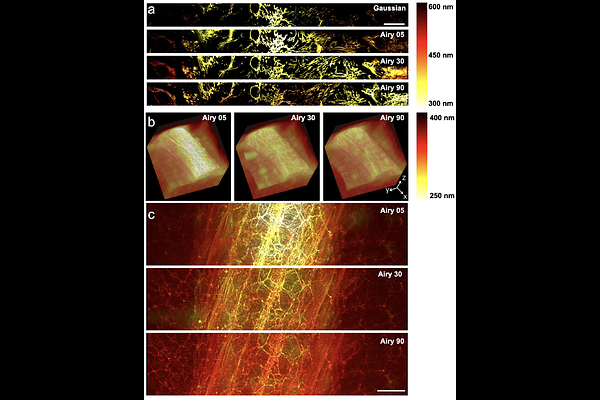
AbstractAn outstanding question in eukaryotic biology is the mechanistic connection between events occurring at (sub)cellular levels (time scales of milliseconds to minutes) to those at the tissue levels (tens of minutes to months). Deciphering such mechanisms requires imaging approaches capable of simultaneously achieving high spatial and temporal resolutions for large samples over long periods of time. Here, we demonstrate Airy beam-based light sheet microscopy of organelles in tens to hundreds of cells in a few hundred micrometre-wide tissue environments. We achieve a typical resolution of 320 nm over 266 by 266 by 100 micrometer cubed volumes at a temporal rate of 0.05 Hz, typically with generally used fluorophores such as Green Fluorescent Protein, over extended periods of time that allow tracking of organelle and protein dynamics. We validated our approach across different length and time scales by imaging mitochondria and endosome dynamics in very large fields of view in zebrafish tissue, molecular assemblies of myosin as gastrulation proceeds in Drosophila embryos, 3D mitochondrial streaming in mouse oocytes, pressure-driven motility and protrusions in amoebae, mitochondrial dynamics in cancer spheroids, 5-colour fast imaging in iBlastoids, and endosomal dynamics in single cells. Through these model systems, we demonstrate the versatility of Airy beam light sheet microscopy to image large tissues at unprecedented high resolution; to capture dynamics in photosensitive, delicate samples; and to screen 3D samples. We anticipate that our Airy beam-based approach will represent a pivotal advance in cellular biology - especially developmental biology - as it provides, for the first time, true subcellular resolution over large imaging volumes with high temporal resolution.