Prophylactic and therapeutic antiviral effects of the influenza A defective interfering particle OP7 in human lung epithelial cells in vitro

Prophylactic and therapeutic antiviral effects of the influenza A defective interfering particle OP7 in human lung epithelial cells in vitro
Opitz, P.; Kuechler, J.; Holdt, K. M.; Hofmann, E.; Ruediger, D.; Kupke, S. Y.; Reichl, U.
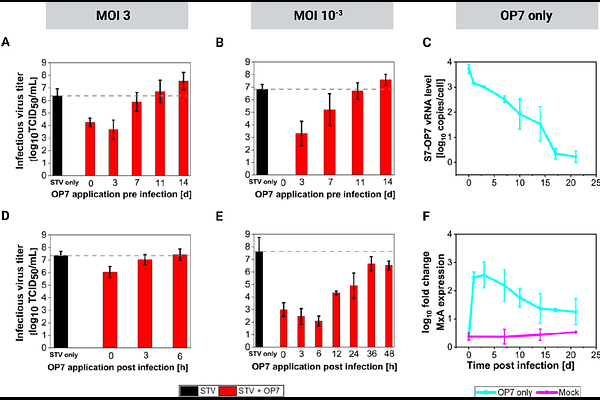
AbstractDefective interfering particles (DIPs) derived from the influenza A virus (IAV) are a promising antiviral agent due to their strong antiviral efficacy demonstrated in various animal models. OP7 is an unconventional IAV DIP with multiple point mutations in the viral RNA (vRNA) of genome segment 7, as opposed to the large internal genomic deletions typically found in conventional IAV DIPs. Further, OP7 showed an even higher interfering efficacy than conventional DIPs. However, the inhibitory effect of OP7 on standard virus (STV) replication has primarily been investigated in Madin-Darby Canine Kidney (MDCK) cells, which lack a functional myxovirus resistance (Mx)-mediated antiviral activity against IAV. In this study, we examined the antiviral activity and mechanism of antiviral action of OP7 in an interferon (IFN)-competent human lung carcinoma cell line (Calu-3) in vitro. We performed STV and OP7 co-infection experiments using a variety of infection conditions and measured the time-resolved dynamics in viral titer, vRNA, protein level, and host cell gene expression. We observed that OP7 co-infection results in enhanced type I IFN responses and markedly reduced infectious virus release, even at low doses. Additionally, we found that at a high STV multiplicity of infection (MOI), the replication interference of OP7, suppressing the replication of STV vRNA, appears to be the dominant mechanism of its antiviral action. At a low MOI, however, IFN induction seems to be more important. Furthermore, we examined the efficacious co-infection time window for potential prophylactic and therapeutic antiviral treatment. We observed an antiviral effect exerted by OP7 infection for up to seven days before STV infection and up to 24 hours after STV infection. Together, these findings demonstrate that OP7 is a potent antiviral DIP. Therefore, this work supports the further development of OP7 as a therapeutic and prophylactic antiviral agent.