WNT-driven chromosomal instability as a biomarker for PORCN inhibition

WNT-driven chromosomal instability as a biomarker for PORCN inhibition
Garcia-Lopez, D.; Zoufir, A.; Hernando, B.; Santamaria, P. G.; Cadiz, A.; De Galard Terraube, H.; Madrid, L.; Cullen, A.; Woodcock, S.; PIskorz, A.; Wallis, N.; Walling, J.; Brenton, J. D.; Markowetz, F.; Yip, J.; Teles, J.; Macintyre, G.
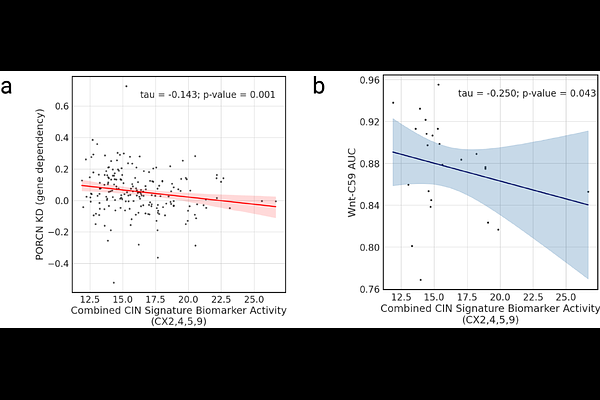
AbstractTargeting Porcupine (PORCN), a key regulator of the WNT-signalling pathway, has shown therapeutic potential in multiple cancers. Despite strong target engagement and acceptable safety profiles through human phase I clinical trials, low phase II efficacy has stalled further clinical development. Given that aberrant WNT signalling can drive tumorigenesis by inducing chromosomal instability (CIN), we hypothesised that genomic CIN signatures might serve as a predictive biomarker to help improve response rates. Using a controlled in vitro model and single-cell whole-genome sequencing, we demonstrate that acute WNT-activation directly induces three distinct types of CIN: whole genome duplication, replication stress, and impaired homologous recombination. We translated these observations into a composite CIN signature biomarker that significantly correlated with both genetic dependency and pharmacological inhibition of PORCN across 195 and 24 cell lines, respectively. Through a large-scale meta-analysis of patient-derived and cell line xenografts, we established that this composite CIN signature biomarker quantitatively predicts in vivo PORCN inhibitor sensitivity (R=-0.71, p<0.002). By applying an optimised biomarker threshold, refined through modelling of human patient data, to the The Cancer Genome Atlas dataset, we successfully retrospectively modelled previous trial results and identified gastroesophageal cancers as a high-prevalence (36.6%) indication for future development. We validated this strategy in a mouse clinical trial of gastric and esophageal xenografts, where biomarker-guided stratification achieved an objective response rate of 60% and significantly decreased risk of progression (HR=0.21, p=0.0345). These data establish an actionable, trail-ready framework for further PORCN inhibitor clinical development.