Animal retrozymes are nonautonomous sequences of Penelope-like elements

Animal retrozymes are nonautonomous sequences of Penelope-like elements
Li, Z.; Clavereau, I.; Pollet, N.
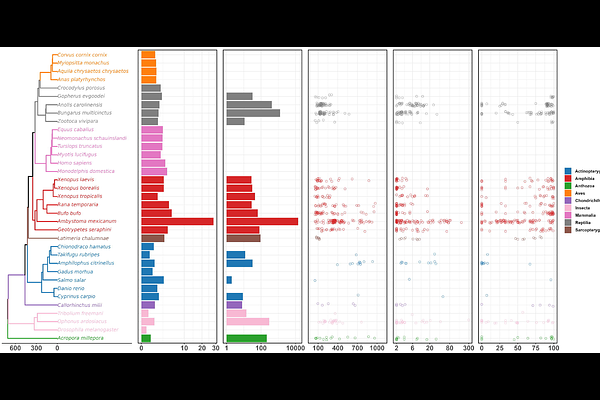
AbstractHammerhead ribozymes (HHRs) are small catalytic RNAs found across diverse life forms. In animals, they can occur as dispersed copies or in tandem genomic arrangements. These tandemly organized forms, known as Non-LTR retrozymes, were recently identified as a distinct group of non-autonomous retrotransposons, likely mobilized via a rolling-circle transposition mechanism and potentially involved in host transcriptome regulation. However, their evolutionary origins remain poorly understood. Here, we investigate the presence, genomic distribution, and possible origins of Non-LTR retrozymes across a broad range of vertebrate species. We find that these elements display a patchy phylogenetic distribution, notably absent from the Aves and Mammalia lineages. In species where they are present, retrozyme copy number, consensus length, and monomer proportion vary widely across species and retrozyme families, suggesting diverse amplification dynamics. Genomic mapping reveals a significant enrichment of Non-LTR retrozymes in intergenic regions and exclusion from genic regions, implying selective pressures against genic insertion. Strikingly, the phylogenetic distribution of Non-LTR retrozymes coincides with that of Penelope-like elements (PLEs). Phylogenetic analysis further shows that the pLTR region of PLEs is closely related to Non-LTR retrozymes, supporting the hypothesis that Non-LTR retrozymes are non-autonomous derivatives of PLEs. Together, our findings shed new light on the evolutionary origin and genomic behaviour of Non-LTR retrozymes and underscore their potential regulatory roles in vertebrate genomes.