Cancer-derived Extracellular Vesicles for Targeted Delivery of EGFRvIII siRNA to Glioblastoma, Comparison of siRNA Loading Methods and Efficiency

Cancer-derived Extracellular Vesicles for Targeted Delivery of EGFRvIII siRNA to Glioblastoma, Comparison of siRNA Loading Methods and Efficiency
Shojaei-Ghahrizjani, F.; Tawil, N.; Meehan, B.; Montermini, L.; Khajeh, M.; Villa, A.; Rak, J. R.; Ciana, P.
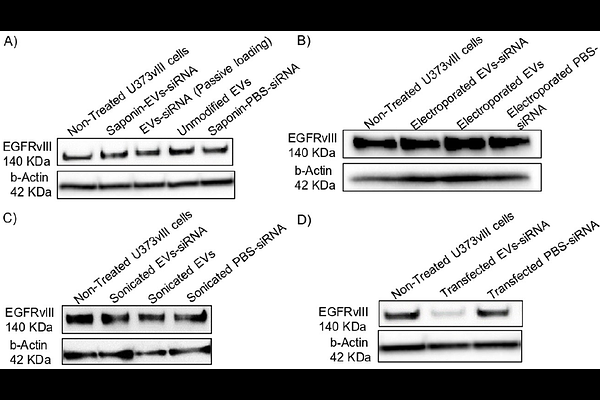
AbstractBackground: Extracellular vesicles (EVs) are nano and macro-sized, lipid-bound particles, involved in cellular communication. Interestingly, cancer-derived EVs show a heterologous and cross-species tumour tropism which makes them a potential tool for efficient delivery of therapeutic small interfering RNA (siRNA) to the tumour cells. Methods: EVs derived from glioblastoma cells (U373P and U373vIII) were loaded with EGFRvIII siRNA to develop a targeted therapeutic strategy against glioblastoma. EV biodistribution was evaluated using fluorescent indocyanine green (ICG) staining followed by ex vivo imaging. Different loading strategies, including passive loading, sonication, saponin-mediated membrane permeabilization, electroporation, and transfection were assessed for their efficiency in loading siRNA into EVs. The efficiency of each method was evaluated by nano flowcytometry, in vitro uptake assay followed by immunoblot (western blot) analysis. Eventually, the most effective formulation was tested for the systemic siRNA administration and selective tumour delivery in vivo, followed by evaluation of tumour size and EGFRvIII expression. Results: Here, we showed that siRNA transfection into EVs was the most effective loading strategy, as confirmed by nano-flow cytometry, uptake assays, and western blot analysis, achieving over 90% knockdown efficiency in vitro for EVs carrying EGFRvIII siRNA. In vivo, EGFRvIII siRNA-loaded EVs homed to the tumour site and downregulated EGFRvIII expression compared with the PBS-siRNA control group; however, no significant tumour shrinkage was observed.