Rotation-Induced Pressure Anisotropy in Newtonian White Dwarfs: Sequences and Applicability Criteria

Rotation-Induced Pressure Anisotropy in Newtonian White Dwarfs: Sequences and Applicability Criteria
Aray Muratkhan, Saken Toktarbay, Hernando Quevedo
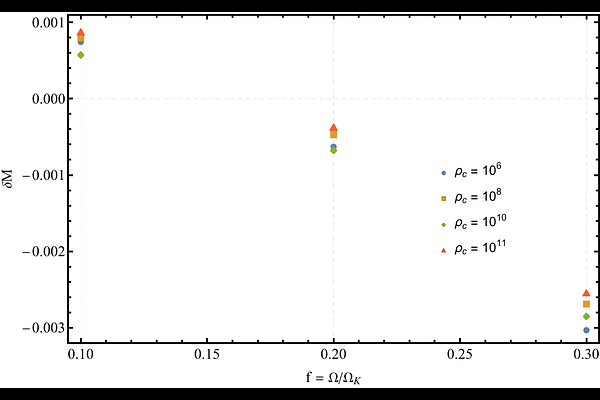
AbstractWe introduce a fast, one-dimensional Newtonian {reduced model} to capture uniform rotation in cold white dwarfs, encoding centrifugal support as an effective pressure anisotropy. Using $Δ_{\rm rot}(r)=\frac{1}{3}ρ(r)Ω^2 r^2$ derived from the stationary Euler equation with $\langle\sin^2θ\rangle=2/3$, the model incorporates rotation into hydrostatic balance without a two-dimensional solver. Applying the Chandrasekhar degenerate-electron equation of state, we compute interior structures and global sequences for $ ρ_c \in [10^6, 10^{11}]~{\rm g\,cm^{-3}} $ with rotation proxies $f \le 0.35$, finding monotonic increases in limiting mass and radius, with a percent-level mass gain at $f = 0.35$. We quantify applicability using sub-Keplerian diagnostics evaluated on the rotating configurations, $\max(Ω/Ω_K)$ and $\max(ε)$, together with a bulk-interior smallness measure $A_{10^{-2}}\equiv \max_{p_r/p_c\ge 10^{-2}}(Δ_{\rm rot}/p_r)$. Within the scanned domain these diagnostics remain below unity. The model is therefore best viewed as a reduced Newtonian benchmark for slow-to-moderate rotation, not as a replacement for fully axisymmetric calculations of rotating stars.