Evidence that injury can cause Drosophila gut differentiated, polyploid enterocytes to be recruited as stem cells via paligenosis

Evidence that injury can cause Drosophila gut differentiated, polyploid enterocytes to be recruited as stem cells via paligenosis
Park, D.; Lawrence, R. M.; Jackson, T.; Li, H.; Mills, J. C.
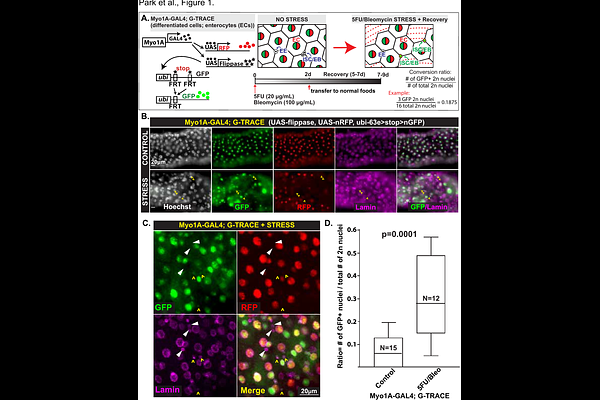
AbstractDifferentiated cells can return to a progenitor-like state in response to injury via the evolutionarily conserved cellular program called paligenosis. Paligenosis proceeds by three stages: 1) autophagy/autodegradation of differentiated cell architecture, 2) metaplasia/progenitor gene induction, 3) TOR complex 1 (TORC1)-dependent cell cycle re-entry. Using multiple injury and reverse-lineage-tracing approaches in the Drosophila gut, we show that mature polyploid enterocytes dedifferentiate into diploid progenitors in response to epithelial injury. Several key findings suggest a role for paligenosis. Shortly after injury, enterocytes dramatically increased autophagic flux (stage 1); additionally, pharmacological and genetic inhibition of autophagy blocked progenitor recruitment. Rapamycin also blocked recruitment, indicating that TORC1 is required (stage 3). Finally, RNAi knockdown of ifrd1, an evolutionarily conserved protein required for paligenosis, blocked progenitor recruitment. Thus, replenishment of diploid progenitors from differentiated polyploid cells may occur by paligenosis. The Drosophila gut may offer a versatile system for dissecting the mechanisms of this evolutionarily conserved pathway.