Tissue-specific consequences of impaired RNA surveillance converge on mitochondrial homeostasis

Tissue-specific consequences of impaired RNA surveillance converge on mitochondrial homeostasis
Higginson, L. A.; Wang, X.; Morton, D. J.
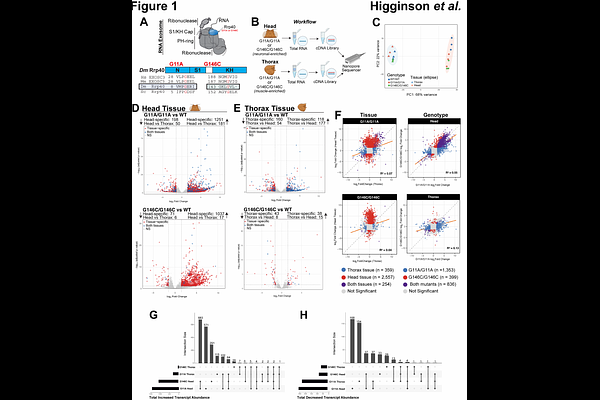
AbstractRNA surveillance pathways maintain transcriptome integrity by eliminating aberrant, excess, and non-functional RNAs, yet it remains unclear whether distinct tissues exhibit equivalent requirements for RNA quality control. Here, we investigated the tissue-specific consequences of impaired RNA surveillance using a Drosophila allelic series of the RNA exosome subunit Rrp40. Comparative transcriptomic analyses revealed that neuronal-enriched head tissue and muscle-enriched thorax tissue exhibit largely distinct molecular programs following reduced RNA exosome activity despite disruption of the same RNA surveillance machinery. Antisense RNAs emerged as particularly sensitive targets of RNA exosome dysfunction, accumulating preferentially in neuronal tissue and largely independent of changes in overlapping sense host transcripts, indicating enhanced requirements for RNA-level quality control within the nervous system. Although tissue-specific transcriptomic alterations diverged substantially, multiple analyses converged on mitochondrial homeostasis as a shared vulnerability. Reduced RNA exosome activity was associated with widespread dysregulation of nuclear-encoded mitochondrial genes, mitochondrial dynamics pathways, and mitochondrial RNA regulatory programs, accompanied by progressive defects in mitochondrial organization, membrane potential, and ATP production. Mitochondrial dysfunction was further associated with activation of proteostatic stress pathways, including p62 accumulation and increased ubiquitination. Together, these findings demonstrate that tissue context shapes the molecular consequences of impaired RNA surveillance while revealing mitochondrial homeostasis as a convergent vulnerability arising from transcriptome instability. More broadly, our findings suggest that distinct tissue-specific defects in RNA regulation converge on common cellular vulnerabilities that ultimately govern tissue homeostasis.