Sex and race shape serum protein biomarkers and bias diagnostic reference intervals

Sex and race shape serum protein biomarkers and bias diagnostic reference intervals
Son, A.; Ji, J.; Han, E.; Choi, Y.; Park, J.; Lee, H.; Park, S.; Kim, H.
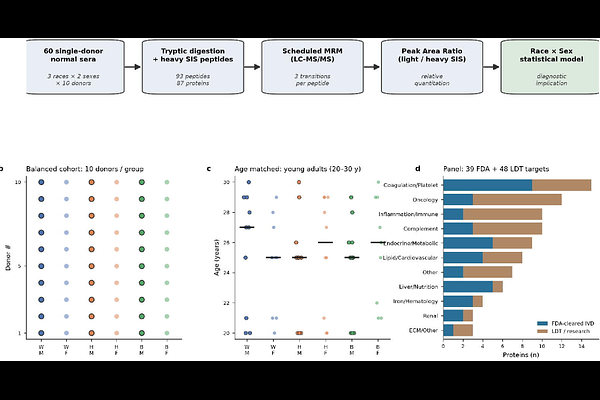
AbstractClinical protein biomarkers, whether measured by FDA-cleared in-vitro diagnostic (IVD) assays or deployed as laboratory-developed tests (LDTs), are routinely interpreted against fixed, population-agnostic reference intervals. Whether the baseline serum concentrations of these proteins differ systematically by sex and by self-reported race in healthy individuals has not been tested across a broad clinical panel on a single standardized platform. Using scheduled multiple reaction monitoring-mass spectrometry (MRM-MS) with stable-isotope-labelled internal standards, we quantified 87 proteins (39 FDA-cleared analytes; 48 LDT/research markers) in 60 healthy, age-matched donors balanced across three races (White, Hispanic, Black) and both sexes. Sex was a pervasive axis of variation: donors separated by sex in unsupervised multivariate space (PERMANOVA p = 0.020) but not by race (p = 0.14). Three FDA-target proteins differed by sex at FDR q < 0.05: sex hormone-binding globulin, haemoglobin-, and albumin, with directions preserved within every race. Race differences were real but protein-specific, exemplified by ancestry-associated CD14. Critically, applying a single pooled 95% reference interval mis-flagged as many as ~25% of a demographic subgroup as abnormal, versus the 5% expected. Demographic context should therefore be incorporated into reference intervals and decision thresholds for protein-based diagnostics.