VDAC2 stabilizes a membrane-inserted, primed intermediate of BAX activation

VDAC2 stabilizes a membrane-inserted, primed intermediate of BAX activation
Ravishankar, V.; Alvero, L.; Hubert, A.; Zhang, Z.; Markarian, C.; Prima, V.; Chergui, S.; Melero, R.; Stengel, F.; Manon, S.; Duneau, J.-P.; Queralt-Martin, M.; Bergboll, L.
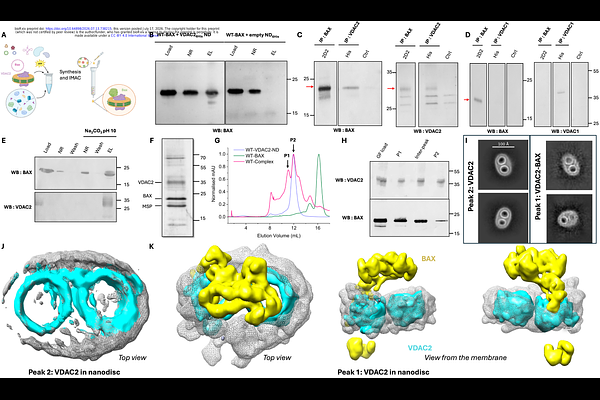
AbstractBAX is a major effector of mitochondrial apoptosis and is activated through a series of conformational transitions that lead to mitochondrial outer membrane permeabilization. Genetic studies have established VDAC2 as an essential regulator of BAX-mediated apoptosis, yet the molecular basis of this regulation remains unresolved. The absence of direct structural and biochemical characterization of VDAC2-BAX interactions has prevented mechanistic understanding of how VDAC2 influences BAX activation. Here, using complementary biochemical, biophysical and structural approaches, we reconstituted and characterized a stable VDAC2-BAX complex. Notably, complex formation was specific to VDAC2 and was not observed with VDAC1, highlighting an isoform-specific role in BAX regulation. We show that VDAC2 captures and stabilizes a primed BAX conformation characterized by membrane insertion, exposure of the BH3 domain, and increased accessibility of the N-terminal activation region. By integrating AlphaFold3 predictions with biochemical, biophysical and structural constraints, we derive an experimentally supported structural model in which BAX is anchored through its 9 helix while its soluble domain partially extends over the VDAC2 pore. Together, our findings support a model in which VDAC2 stabilizes a membrane-inserted, activation-competent BAX intermediate. Rather than serving as a structural component of apoptotic pores, VDAC2 acts as a checkpoint that regulates progression along the BAX activation pathway. These results provide a molecular explanation for the long-recognized requirement of VDAC2 in mitochondrial apoptosis and establish an experimentally supported structural framework for a previously inaccessible intermediate in the BAX activation pathway.