Organism-scale annotation with Pan-human Azimuth

Organism-scale annotation with Pan-human Azimuth
Sarkar, S.; Li, Z.; Molla, G.; Shenoy, A.; Zhang, B.; Collins, D.; Vasilevsky, N.; Gaut, J. P.; Puig-Barbe, A.; Bueckle, A.; Osumi-Sutherland, D.; Börner, K.; Jain, S.; Satija, R.
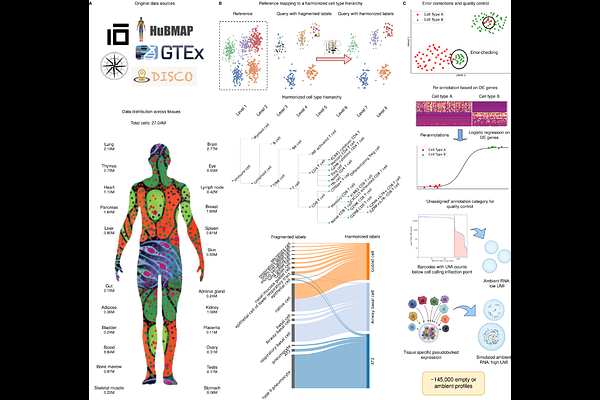
AbstractSingle-cell atlases now span many human tissues, but inconsistent annotations across studies limit their utility as a unified reference. We introduce Pan-human Azimuth, a supervised neural network that maps human cells from diverse tissues and datasets onto a single hierarchical organism-scale typology. Developed through NIH HuBMAP, the model is trained on a uniquely curated corpus designed to maximize diversity across tissues and technologies while enforcing uniform, interpretable annotations and stringent quality control. The use of a single organism-wide reference enables us to map tens of millions of cells in the Tabula Sapiens and scBaseCamp repositories, perform cross-tissue comparisons across thousands of samples, and identify striking tissue specialization among fibroblast states. Pan-human Azimuth naturally extends to annotating spatial transcriptomic data, recovering canonical kidney cortical structures and distinguishing glomerular states consistent with expert pathology. We release Pan-human Azimuth alongside cloud, R, and Python interfaces to facilitate standardized organism-wide single-cell analysis.