The tumour suppressor RBM5 activates the helicase DHX15 to regulate splicing

The tumour suppressor RBM5 activates the helicase DHX15 to regulate splicing
Liu, S.; Su, T.; Huang, J.; Lin, C.-H.; Black, D. L.; Damianov, A.; Zhou, Z. H.
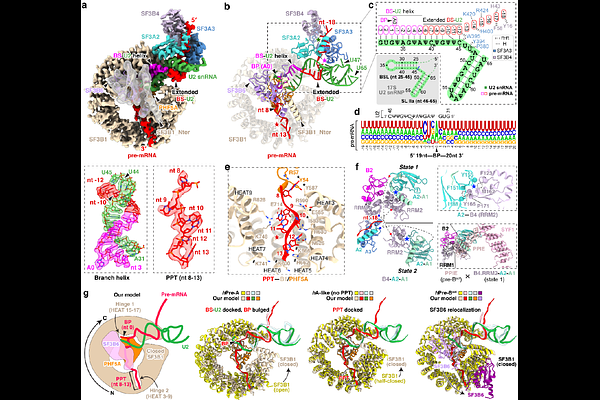
AbstractPre-mRNA splicing determines the expressed proteome and is frequently dysregulated in cancer. The tumour-suppressor RBM5 controls an exon network regulating apoptosis, yet its molecular mechanism is elusive. Using in vivo spliceosome capture and cryogenic electron microscopy, we determined structures of precatalytic spliceosomes arrested by RBM5 immediately after U2 snRNP branchpoint recognition. Despite intron diversity, the U2-pre-mRNA duplex, branchpoint adenine, and downstream polypyrimidine tract are well-resolved. RBM5 binds the outer SF3B1 HEAT surface and performs dual functions: First, its helix-loop-helix motif and upstream zinc-finger domain sterically block tri-snRNP and Prp8 docking and prevent progression to pre-B and Bact complexes; Second, its G-patch activates DHX15 and places this DExH-box helicase on the pre-mRNA as it exits SF3B1, poised for branch helix unwinding. DHX15 binding to SF3B1 is facilitated by U2SURP/SR140, which engages SF3B1 near RBM5's helix-loop-helix. Functional assays confirm that disruption of the RBM5 interfaces with either DHX15 or SF3B1 inhibit exon repression. Mutations at these regulatory interfaces are common in cancer genomes and predicted to disrupt its regulation of apoptotic isoforms. Thus, RBM5 acts as a dual-action spliceosome gatekeeper that couples helicase activation with physical stalling to enforce tumour-suppressive alternative splicing programmes.