Architectural chromatin interactions provide a framework for context-dependent gene regulation

Architectural chromatin interactions provide a framework for context-dependent gene regulation
Likhite, M.; Andrews, G. R.; Gao, M.; Ramalingam, V.; Hecht, V.; Kundaje, A.; Moore, J. E.
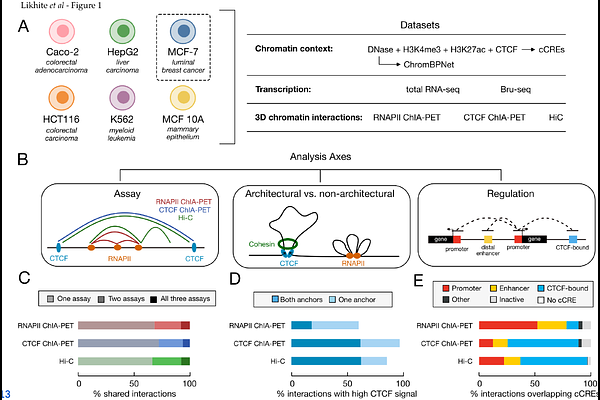
AbstractGene regulation depends on coordinated interactions between promoters and distal cis-regulatory elements, yet understanding how these regulatory elements communicate remains a fundamental challenge in mammalian genomics. Chromatin interaction assays provide one approach for identifying potential regulatory relationships, but interpreting the biological significance of individual interactions remains difficult; chromatin interactions comprise multiple biologically distinct classes that are only partially captured by any single assay. Here, we integrate Hi-C, RNAPII ChIA-PET, and CTCF ChIA-PET with the ENCODE Registry of candidate cis-regulatory elements (cCREs) and complementary functional genomic datasets to develop an integrative framework for classifying and interpreting promoter-centric chromatin interactions. Using this framework, we identify a distinct class of candidate architectural promoter-enhancer interactions that are characterized by increased recurrence across cellular contexts, broader promoter connectivity, and reduced dependence on linear genomic proximity. We further show that many regulatory elements anchoring these interactions transition between enhancer and CTCF-only states while maintaining stable chromatin interactions. These dual-state regulatory elements also acquire context-specific transcription factor inputs within evolutionarily conserved architectural scaffolds, suggesting that stable chromatin architecture can be repeatedly repurposed for new regulatory functions. Genes connected to these dual-state regulatory elements are enriched for developmental and signaling pathways and exhibit increased expression specificity across cell types, consistent with specialized roles in context-dependent gene regulation. Together, our findings provide a biologically informed framework for classifying and interpreting chromatin interactions and support a model in which conserved chromatin architecture provides a stable foundation upon which new regulatory programs evolve.