A Unified Dynamical-Systems and Control-Theoretic Model for Single-Cell Fate Dynamics

A Unified Dynamical-Systems and Control-Theoretic Model for Single-Cell Fate Dynamics
Redd, D. M.; Green, S. G.; Terooatea, T. W.
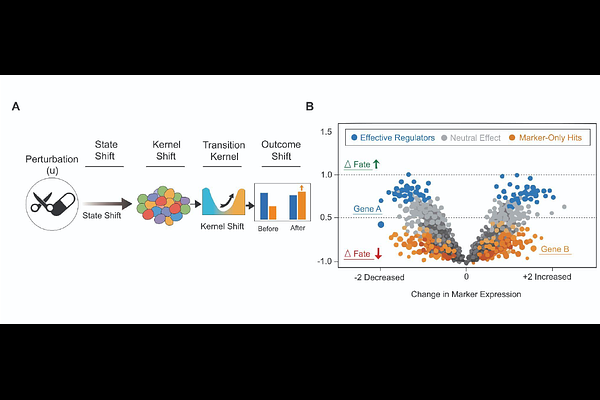
AbstractSingle-cell technologies now resolve cell-fate transitions, yet most analyses remain descriptive rather than predictive. This model unifies pseudotime (geometry), RNA velocity (local direction), optimal transport (OT; distributional evolution) and Schrodinger-bridge approaches (stochastic trajectories) within a stochastic dynamical-systems and control lens under partial observability. We provide a minimal bridge from Chemical Master Equation models to SDE/Fokker-Planck descriptions and quasi-potentials, clarify what can and cannot be identified from snapshot data, and outline practical experimental design (time points, modalities, perturbations). We summarize method-specific assumptions, strengths and failure modes; present case studies (iPSC reprogramming, pancreas endocrinogenesis, hematopoiesis at scale); and detail a 10-step workflow with uncertainty propagation and reporting standards. Finally, we recast intervention as a control problem: the realistic objective is probabilistic programmability-shifting terminal fate distributions with minimal inputs and preserved viability-rather than deterministic state-to-state command.