HAP40 functions as a proteostasis regulator by controlling huntingtin interactions and its release into the extracellular space

HAP40 functions as a proteostasis regulator by controlling huntingtin interactions and its release into the extracellular space
Silva Ramos, E.; Boeddrich, A.; Haenig, C.; Trepte, P.; Ammar, O.; Secker, C.; Popp, O.; Ivanov, A.; Keith, B.; Harding, R. J.; Schindler, F.; Koudelka, T.; Roth, L.; Scharek, N.; Zenkner, M.; Neuendorf, N.; Golusik, S.; Beetz, S.; Mertins, P.; Piazza, I.; Schnoegl, S.; Wanker, E. E.
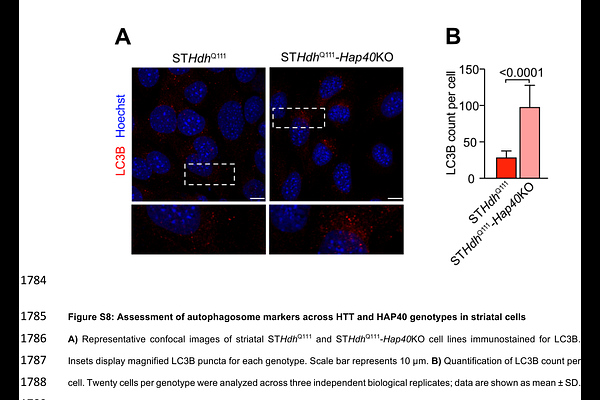
AbstractHuntingtin-associated protein 40 (HAP40) forms a stable protein complex with huntingtin (HTT). Its cellular function and how HAP40 loss influences mutant HTT (mHTT) abundance and pathobiology are currently unclear. Here, using diverse cellular models and OMICs methods, we demonstrate that HAP40 is an obligate interaction partner of full-length HTT and through its binding controls the abundance of HTT-associated proteins, indicating that it functions as HTT interaction regulatory unit. Also, loss of HAP40 in mHTT-expressing striatal cells impairs autophagosome-lysosome flux, triggers massive transcriptional dysregulation, including the activation of the CLEAR network, demonstrating that it functions as proteostasis regulator that acts on quality control pathways. Finally, mHTT-expressing cells lacking HAP40 showed increased secretion of mHTT through the ER-to-Golgi route, indicating that striatal cells reduce intracellular mHTT-induced proteotoxicity through activation of secretory pathways. Together, these results establish HAP40 as a critical proteostasis regulator that through controlling HTT interactions maintains cellular homeostasis.