Crystal structures of a far-red photoreceptor in different light-absorbing states: insights into spectral tuning and light signaling

Crystal structures of a far-red photoreceptor in different light-absorbing states: insights into spectral tuning and light signaling
Biju, L. M.; Ren, Z.; Kraskov, A.; Bandara, S.; Norouzi Sardareh, E.; Wei, C.; G. Rao, A.; Schapiro, I.; Hildebrandt, P.; Yang, X.
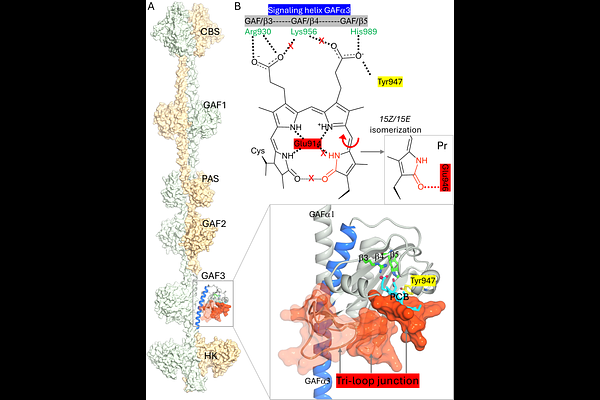
AbstractCyanobacteriochromes (CBCRs) are bilin-binding photoreceptors with remarkable spectral versatility. Using phycocyanobilin (PCB) as a chromophore, CBCRs regulate diverse light-dependent processes in cyanobacteria, ranging from photosynthesis to chromatic acclimation. Although extensive studies have uncovered multiple spectral tuning mechanisms in bilin-binding proteins, recent structural studies of far-red CBCRs suggest the existence of additional tuning strategies in both the 15Z and 15E states. Here we report crystal structures of the representative far-red CBCR Anacy_2551g3 in three distinct light-absorbing states, all of which adopt a compact all-syn PCB conformation. These structures demonstrate that 15Z/15E photoisomerization in Anacy_2551g3 involves minimal chromophore rotation relative to the GAF domain, in stark contrast to other characterized bilin-based photoreceptors. To investigate the molecular basis of its far-red absorption, we examined the protonation and tautomeric states of PCB in the Pfr state using resonance Raman (RR) spectroscopy and quantum mechanics/molecular mechanics (QM/MM) calculations. Comparisons of experimental and calculated RR spectra support a bilin lactam as the predominant tautomeric form in the Pfr state. Integrating structural, spectroscopic, computational and mutational analyses, we propose that specific protein-chromophore interactions play critical roles in modulating chromophore conjugation beyond bilin coplanarity. Structural analyses further suggest a signaling model in which light regulation by Anacy_2551g3 is mediated through reversible switching between a high-affinity Pfr state and a low-affinity Po state that does not involve large chromophore motions. Together, these results provide new insights into how protein-chromophore coupling governs spectral tuning and light signaling in bilin-based photoreceptors.