Simultaneous Multi-band Optical Follow-up Observations of a Gamma-Ray Flare in BL Lacertae

Simultaneous Multi-band Optical Follow-up Observations of a Gamma-Ray Flare in BL Lacertae
X. Chang, D. R. Xiong, Chenxu Liu, J. R. Xu, G. Bhatta, T. F. Yi, J. Zhang, Y. Pan, X. Z. Zou, X. L. Chen, Y. P. Yang, J. H. Zhang, X. K. Liu, Y. Fang, G. W. Du, T. Wang, X. F. Zhu, Y. L. Gong, Z. X. Wang, X. W. Liu
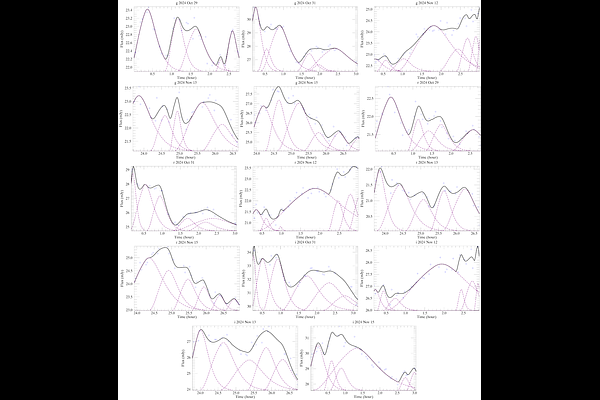
AbstractOn $2024$ October $5$, BL Lacertae ($2200+420$) experienced one of its brightest gamma-ray flares. We conducted simultaneous follow-up observations in the $u$, $v$, $g$, $r$, $i$, and $z$ bands from $2024$ October $17$ to November $21$ using the Mephisto telescope and its two $50$ cm twin auxiliary photometric telescopes of Yunnan University. Intraday variability (IDV) was detected in the $g$, $r$, $i$, and $z$ bands. The IDV duty cycle increased with observing frequency across these bands. The shortest variability time-scale, derived from auto-correlation analysis, constrains the upper limit of the black hole mass to be $M_{\bullet} \lesssim 10^{8.29} M_{\odot}$ assuming a Kerr black hole, and $M_{\bullet} \lesssim 10^{8.77} M_{\odot}$ assuming a Schwarzschild black hole. The emission region responsible for the observed variability has a size of $R \le 3.51 \times 10^{14}$ cm and is located at a distance of $R_H \le 2.83 \times 10^{15}$ cm from the central supermassive black hole. This distance is approximately three orders of magnitude smaller than the typical radius of the broad-line region, indicating that the emission region lies well within it. A general bluer-when-brighter (BWB) trend was detected on intraday time-scales, suggesting that shock-accelerated relativistic electrons enhance the high-energy particle population, leading to spectral hardening. A potential quasi-periodic oscillation (QPO) with a period of $\sim 100.77$ minutes was detected with $>99.99$ per cent confidence, consistent with predictions from the magnetic reconnection model. These observed optical intraday variabilities and colour variations of BL Lacertae can be well explained by the turbulent jet model.