OLD sentinel: an abortive tRNase surveys phage replication and DNA defects in RecBCD-compromised cells

OLD sentinel: an abortive tRNase surveys phage replication and DNA defects in RecBCD-compromised cells
Derzhaev, A.; Zhang, J.; Gavrilov, A. A.; Belukhina, S.; Shenfeld, A.; Depardieu, F.; Saudemont, B.; Shamovsky, I.; Epshtein, V.; Demkina, A.; Song, H.; Burenina, O.; Skutel, M.; Tikhomirova, M.; Molodtsov, V.; Severinov, K.; Nudler, E.; Bikard, D.; Wang, C.; Isaev, A.
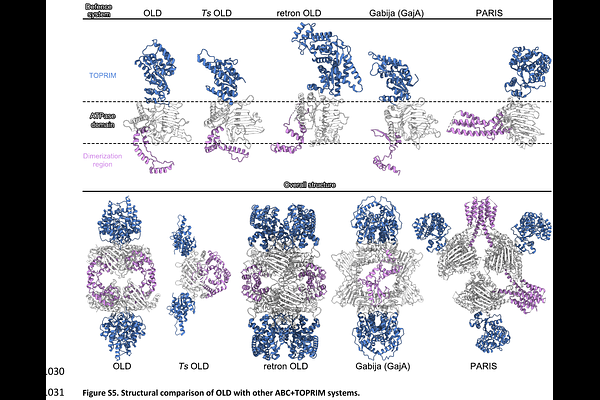
AbstractOLD, an abortive immunity protein from prophage P2, consists of an ABC ATPase sensor and a TO-PRIM nuclease effector - a core architecture shared by a large protein family, including components of anti-phage systems Gabija, PARIS, Septu, and Lamassu. OLD was originally identified for its lethality in recB-deficient cells and inhibition of bacteriophage {lambda} infection, but the mechanisms governing its activation have remained elusive. Here, we present the cryo-EM structure of an inactive OLD tetramer and show that destabilization into dimeric form opens the TOPRIM catalytic site, stimulating tRNA cleavage. This activity arrests translation, a phenotype rescued by phage-encoded tRNAs. We demonstrate that OLD activation is not strictly RecBCD-dependent: OLD binds aberrant DNA structures in recB-deficient cells, but activation during infection requires recognition of single-stranded DNA hairpins at the phage replication origin. Collectively, our findings reveal how host and phage DNA processing factors create a complex landscape controlling OLD-mediated immunity.