In vivo lineage tracing across human tissues using methylation barcodes in the protocadherin gene cluster

In vivo lineage tracing across human tissues using methylation barcodes in the protocadherin gene cluster
Hackett, S. F.; Boniface, C. T.; Fonseca, A. V. A.; Ramos-Yamasaki, A. D.; Watson, C.; Bazin, H. M. L.; Tan, A. B.; Lee Yu, H.; Hanssen, L. L. P.; Dev, H.; Apostolidou, S.; Gentry-Maharaj, A.; Esener, S.; Menon, U.; Blundell, J. R.
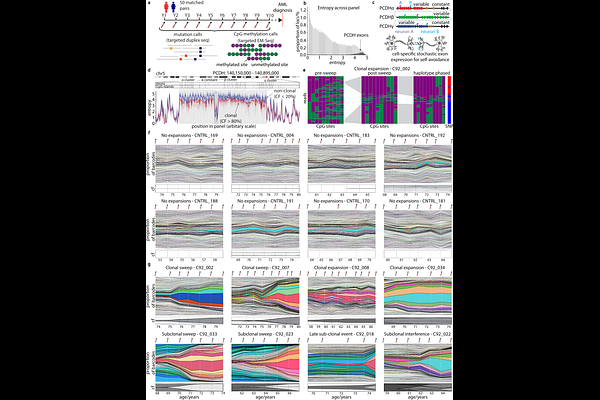
AbstractResolving the lineage history of human cells is fundamental to understanding ageing and cancer but remains hampered by a lack of native, high-resolution markers. Here, we identify the protocadherin (PCDH) gene cluster as a naturally occurring, highly diverse methylation barcode. While PCDH methylation creates neuronal diversity in the brain, we show that stochastic methylation patterns in this region are maintained as heritable, evolvable lineage markers across multiple non-neuronal tissues, including blood, kidney, prostate, and bladder. By tracking these barcodes in serial samples over a decade, we reveal clonal dynamics with high fidelity, quantitatively recapitulating genetic clone sizes. Crucially, PCDH barcodes identify "cryptic" clonal expansions invisible to standard driver-mutation sequencing and resolve subclonal architectures via continuous epimutation. This native barcoding system provides a scalable, driver-agnostic framework for reconstructing somatic evolution in humans.