Open or closed? Exploring the conformational heterogeneity of human plasminogen across multiple resolution scales

Open or closed? Exploring the conformational heterogeneity of human plasminogen across multiple resolution scales
Kasiarova, L.; Verma, N.; Pinkas, M.; Henek, T.; Klumpler, T.; Chovancikova, M.; Reutova, H.; Kasparek, P.; Hlozankova, M.; Damborsky, J.; Novacek, J.; Hernychova, L.; Marek, M.
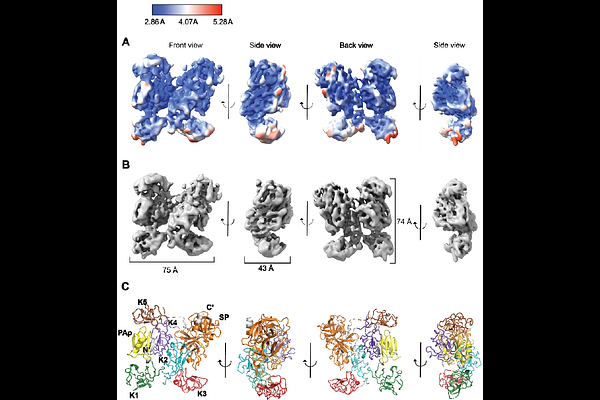
AbstractPlasminogen (Plg), the zymogen of the fibrinolytic protease plasmin, is a multidomain, conformationally-rich protein that plays a crucial role in targeted thrombolysis for stroke and heart attack treatments. Yet, the conformational state that affects binding to Plg activators and fibrinolytic activity is rarely validated, contributing to poor reproducibility and failures in drug development. Here, we establish a structural biology workflow to characterize human Plg suspended in an aqueous solution, preserving it in a near-native state and eliminating the need for crystal growth. Two variants, cleavage-resistant Plg-RV (R561A) and catalytically inactive Plg-CAT (S741A), were expressed in mammalian cells. Both variants were correctly folded and stable (Tm = 60.6{degrees}C) and, unlike commercial plasma-derived Plg, were resistant to staphylokinase-mediated activation. Small-angle X-ray scattering and hydrogen-deuterium exchange mass spectrometry revealed substantial conformational heterogeneity. The recombinantly-produced Plg variants adopted a closed conformation, exhibiting a good fit to the closed structure determined by X-ray diffraction. Conversely, the plasma-derived Plg populated an extended, open-like state. Cryo-EM analysis of the Plg-RV variant yielded a 4.4 [A] resolution map, and a rigid-body-fitted model revealed the closed-state architecture. Our findings demonstrate that rigorous structural validation of Plg is essential for future functional studies and rational development of next-generation thrombolytic agents.