Community-Based Surveillance for Highly Pathogenic Avian Influenza Viruses among Deceased Birds

Community-Based Surveillance for Highly Pathogenic Avian Influenza Viruses among Deceased Birds
Marushchak, L.; Cotter, C.; Oguzie, J.; Keiser, P.; Nguyen-Tien, T.; Rodriguez, J.; Shittu, I.; Trujillo-Vargas, C.; Wolff, A.; Ryans, S.; Kaufman, R.; Clack, J.; McLellan, S.; Olinger, G.; Gray, G. C.
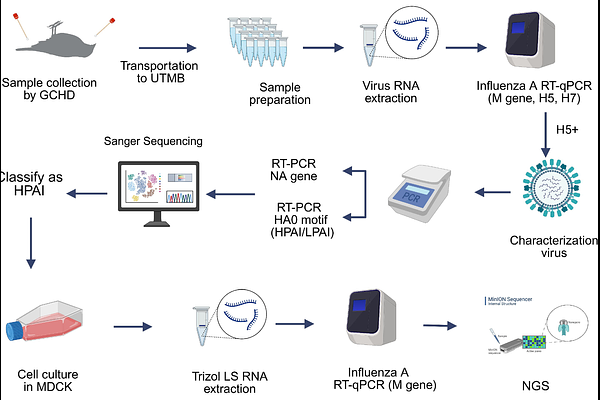
AbstractHighly pathogenic avian influenza (HPAI) viruses of H5N1 clade 2.3.4.4b, are spreading worldwide, posing a threat to wildlife, domestic animals, and humans. In 2025, a multidisciplinary collaboration for HPAI H5N1 surveillance among birds within Galveston County, Texas, was initiated. Between November and December 2025, oropharyngeal and cloacal swabs were collected from wild and domestic birds reported as dead or dying by Galveston County residents. Specimens were studied with molecular assays, Sanger sequencing, virus isolation, and next-generation sequencing. Molecular evidence of HPAI H5N1 was detected in 7 of 10 (70%) birds, and the virus was successfully cultured in MDCK cells. Next-generation sequencing analysis of eight influenza A genome segments demonstrated a 4:4 gene segment reassortant constellation within clade 2.3.4.4b, consistent with genotype D1.1. Community members exposed to HPAI were offered antiviral prophylaxis. No human infections were identified. This surveillance demonstrates that community involvement combined with cross-sectoral collaboration can ensure rapid detection and characterization of circulating avian influenza viruses. Sustained local surveillance is essential for early warning, risk assessment, and prevention of virus spread to poultry, mammals, and humans.