Molecular models for Gram-positive bacterial strains: Assessing membrane properties and small molecule interactions for S.aureus, S. epidermidis and N. lacusekhoensis

Molecular models for Gram-positive bacterial strains: Assessing membrane properties and small molecule interactions for S.aureus, S. epidermidis and N. lacusekhoensis
Vaiwala, R.; Christy, E.; Waskar, M.; Ayappa, K. G.
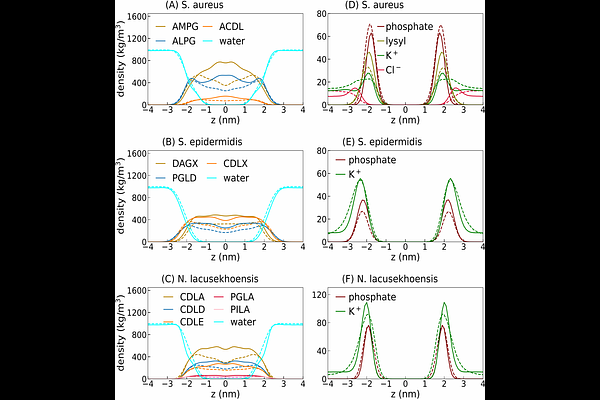
AbstractWe present a comparative study of the inner membrane of three Gram-positive bacterial strains, namely S. aureus, S. epidermidis and N. lacusekhoensis. A lipidomics study is used to obtain the lipid architecture and composition for S. epidermidis found in the skin microbiome and N. lacusekhoensis, an extremophile present in halophilic and alkophilic environments. Differences between the strains arise from both the lipid architecture and the cardiolipin content varying from 5% in S. aureus to 85% in N. lacusekhoensis. We develop coarse grained (CG) Martini-3 membrane models which reproduce structural properties such as membrane area, thickness, density distributions as well as ion-correlations with all-atom models. Inter-lipid correlations reveal a homogeneous distribution of lipids in the membranes despite the wide variation in lipid types and composition. Mechanical properties such as the area stretch modulus increased with cardiolipin content, however the bending modulus has a more complex dependence on membrane charge and lipid type. Using the CG models we evaluate the insertion free energies for four widely used antimicrobial molecules. Entry barriers for thymol and methylparaben arise from the charge density modulation at the membrane headgroups due to counterion condensation. The entry mechanisms of the antimicrobial peptide cecropin-melittin-15 (CM15) and the preservative molecule ethyl-lauroyl-arginate (ELAR) are found to be similar across all three strains. We also illustrate the manner in which the extremophilic strain, N. lacusekhoensis with its high cardiolipin content, modulates the partitioning kinetics of the antimicrobial molecule thymol with pH and salt. Our study reveals that membrane properties are largely conserved across the three model membranes. The molecular models and insights emerging from the present work should aid in the development of novel antimicrobials against Gram-positive strains.