Photoswitchable optoGPCRs for reversible control of Gs and arrestin signalling

Photoswitchable optoGPCRs for reversible control of Gs and arrestin signalling
Walter, D.; McDowell, R.; Isaikina, P.; Pantiru, A.; Ravimohan, H.; Deupi, X.; Lucas, R. J.; Schertler, G. F. X.
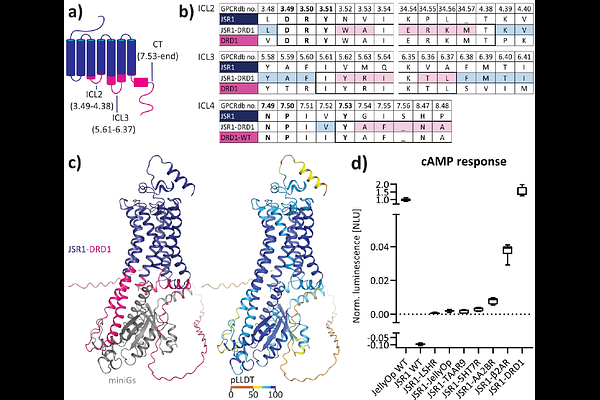
AbstractOptoGPCRs are light-activatable G protein-coupled receptors (GPCRs) used for optogenetic control of physiological processes. Most existing optoGPCRs are based on monostable opsins, which are limited by photobleaching and irreversibility. The bistable jumping spider rhodopsin 1 (JSR1) carrying the single point mutant S199F introduces a [~]150 nm spectral separation between the active and inactive states, enabling bidirectional control with distinct wavelengths of light. Here, we show that JSR1-S199F demonstrates robust, light-reversible arrestin recruitment and Gq/i protein activity. We then engineered JSR1-S199F-based optoGPCRs with Gs protein activity, expanding the limited repertoire of bistable Gs-coupled opsins. Specifically, we present optoDRD1, a chimeric optoGPCR that redirects the native Gq/i protein activity of JSR1 towards the Gs pathway of the dopamine D1 receptor (DRD1). Through systematic screening of intracellular domain combinations, we identified an optimal chimeric configuration comprising ICL2, ICL3, helix 8, and the C-terminus from DRD1. The resulting optoGPCR is activated by violet light ({lambda}max = 397 nm) and deactivated by green light ({lambda}max = 531 nm) at physiologically relevant light intensities. A single violet light pulse drives sustained Gs signalling for several hours, while green light deactivation enables precise signal termination at any timepoint. OptoDRD1 closely mimics wild-type DRD1 signalling kinetics and G protein selectivity. Compared to JellyOp, the only previously characterised natively Gs-coupled opsin, optoDRD1 shows higher signal amplitude and reversibility over multiple light cycles. We further demonstrate optoDRD1s utility for optogenetic control of Gs-regulated processes in vitro, including insulin secretion in human {beta}-cells and signalling modulation in a neuronal cell line, supporting its potential for in vivo applications. The biochemical stability and known structure of JSR1 make it a robust scaffold for this rational engineering and for future biophysical characterization. Together, optoDRD1 and JSR1-S199F expand the optoGPCR toolkit and open new opportunities for dissecting dopaminergic signalling, Gs-mediated physiology, and GPCR signalling pharmacology.