AT2024lhc and AT2024kmq in the landscape of featureless tidal disruption events

AT2024lhc and AT2024kmq in the landscape of featureless tidal disruption events
Yuhan Yao, Ryan Chornock, Andrew Mummery, Raffaella Margutti, Marat Gilfanov, Muryel Guolo, Eric R. Coughlin, Wenbin Lu, Joheen Chakraborty, Dheeraj R. Pasham, Kate D. Alexander, Olivia Aspegren, Charlotte R. Angus, Xinze Guo, Xander J. Hall, Erica Hammerstein, K. -Ryan Hinds, Anna Y. Q. Ho, Xiaoshan Huang, Elias Kammoun, Natalie LeBaron, Matteo Lucchini, Zoë McGrath, Matt Nicholl, Daniel A. Perley, R. Michael Rich, Genevieve Schroeder, Xinyue Sheng, Jesper Sollerman, Jean Somalwar, Jacob R. Wise, Michael W. Coughlin, Andrew Drake, Matthew J. Graham, George Helou, Joahan C. Jaimes, Mansi M. Kasliwal, Ashish A. Mahabal, Pavel Medvedev, Josiah Purdum, Ben Rusholme, Rashid Sunyaev
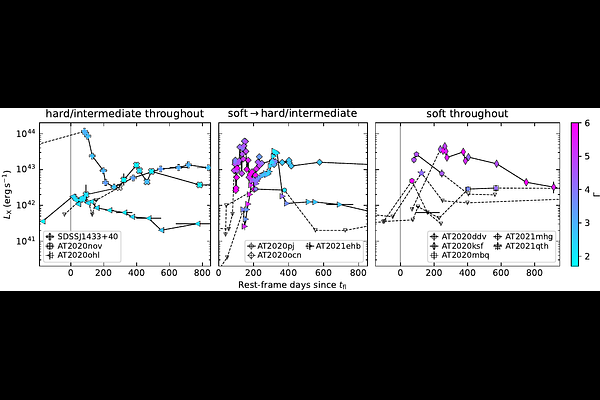
AbstractWe study AT2024kmq and AT2024lhc, two tidal disruption events (TDEs) with blue featureless spectra associated with high-mass black holes ($M_{\rm BH}\sim 10^8\,M_\odot$). Both events show optical precursors consistent with shock dissipation from stream self-intersection. Their X-ray emission is luminous ($L_{\rm X}\sim 10^{44}\,{\rm erg\,s^{-1}}$), highly variable (with minimum observed variability timescales of 1.3\,hr and 4.8\,hr for factor of $\sim3$ flux changes), long-lasting ($>1\,\rm yr$), emerging no later than the optical peak, and well characterized by power-laws with $1.7<Γ<3$ (where $f_ν\propto ν^{1-Γ}$). The X-ray properties and radio non-detections support a compact corona ($\lesssim 10 r_{\rm g}$) producing Comptonized X-ray emission. Using all published featureless TDEs, we find statistically significant bimodality in the distribution of their peak UV/optical blackbody luminosities and radii. We assemble a comparison TDE sample with early-time X-ray observations with eROSITA, in which we find different $M_{\rm BH}$ distributions in TDEs with different X-ray spectral evolution properties: low-mass black holes ($M_{\rm BH} \sim 10^6 M_\odot$) remain soft ($Γ>4$) within $t\lesssim 2$\,yr, intermediate masses ($\sim 10^7 M_\odot$) transition from soft to hard at $\sim$1 yr, while high masses ($\sim 10^8 M_\odot$) are hard ($1.5<Γ\lesssim 3$) from the outset. We interpret this result as evidence that the soft-to-hard state transition in TDEs occurs at the critical threshold of $\dot{M}_{\rm acc} \sim 0.03 \dot M_{\rm Edd}$ (similar to X-ray binaries), using the fact that the transition timescale predicted by simple disk theory scales with black hole mass as $t_{\rm tr}\propto M_{\rm BH}^{-3/4}$.