Suppressing Bone Resorption and Promoting Mineralization with Tetracycline Derivatives

Suppressing Bone Resorption and Promoting Mineralization with Tetracycline Derivatives
Shimochi, S.; Hrovat, K.; Sarwer, U.; Bergara Muguruza, L.; Alho, A.; Laine, M.; Otaka, A.; Iwasaki, Y.; Paatero, I.; Gursoy, U. K.; Makela, K.; Savontaus, E.; Salonen, J.; Nakamura, M.
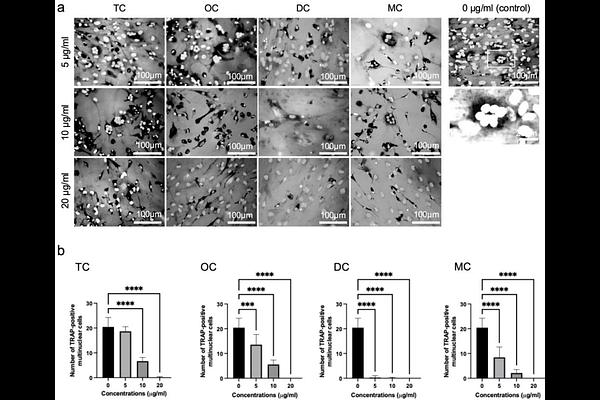
AbstractOsteoporosis is a progressive skeletal disorder characterized by decreased bone mass and an increased risk of fracture. Current treatments are limited by adverse effects and poor long-term compliance, necessitating alternative therapeutic approaches. Tetracycline (TC) derivatives, which are traditionally used as antibiotics, have shown promise in modulating bone remodeling. In this study, the effects of TC and three TC derivatives oxytetracycline (OC), doxycycline (DC), and minocycline (MC) on osteoclast and osteoblast activities were investigated using in vitro human cell models and in vivo zebrafish assays. All TC derivatives inhibited osteoclast differentiation and bone resorption, as shown by reductions in the number of TRAP-positive cells, resorption pit volume, and matrix metalloproteinase (MMP)-2/MMP-9 secretion. DC demonstrated the most potent inhibitory effects across all concentrations. Low to moderate concentrations of OC, DC, and MC promoted osteoblast proliferation and mineralization, whereas high doses inhibited these processes. Confocal imaging confirmed the accumulation of TC derivatives in mineralized bone nodules. Zebrafish studies revealed dose-dependent suppression of craniofacial bone development at higher concentrations. These findings highlight the dose dependent, dual effects of TC derivatives on bone cells (osteoblasts and osteoclasts) and underscore the potential of these agents as dual-function therapies for osteoporosis.