MOAflow: how re-design a pipeline with Nextflow streamlines data analysis

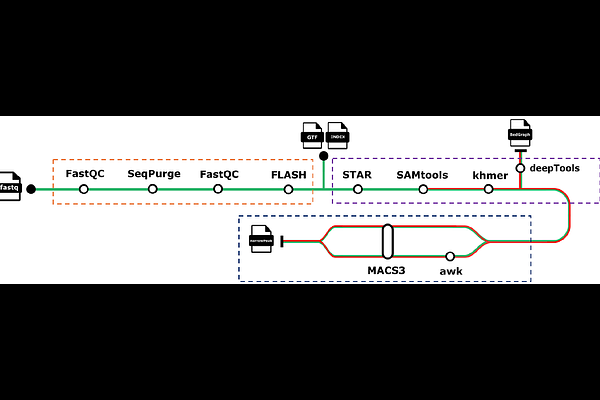
MOAflow: how re-design a pipeline with Nextflow streamlines data analysis
Tartaglia, J.; Giorgioni, M.; Cattivelli, L.; Faccioli, P.
AbstractBackground Advances in high-throughput DNA sequencing technologies have dramatically reduced the time and cost required to generate genomic data. As sequencing is no longer a limiting factor, increasing attention must be paid to optimizing the analyses of the large-scale datasets produced. Efficient processing of such data is essential to reduce computational time and operational costs. In this context, workflow management systems (WMSs) have become key instruments for orchestrating complex bioinformatic pipelines. Among these systems, Nextflow has emerged as one of the most widely adopted solutions in bioinformatics. Methods To improve scalability and computational efficiency, we employed Nextflow to re-design an already existing pipeline dedicated to the analysis of MNase-defined cistrome-Occupancy (MOA-seq) data. The re-engineering process focused on modularizing the workflow and integrating containerization technologies to ensure reproducibility and easier deployment across heterogeneous computing environments. Results The resulting workflow, named MOAflow, represents a modernized and fully containerized pipeline for MOA-seq data analysis. With only Docker and Nextflow required, the pipeline guarantees high portability and reproducibility. The data of the original article was used to benchmark the new pipeline. Its outputs closely match those of the original study with minor variations. Conclusions MOAflow demonstrates how the adoption of robust WMS can substantially enhance the performance and usability of pre-existing bioinformatic pipelines. By leveraging containerization and Nextflow, it ensures consistent results across platforms while minimizing setup complexity. This work highlights the value of modern WMS-driven approaches in meeting the computational demands.