Reversion of pyrethroid resistant phenotypes in Aphis glycines by topical delivery of dsRNA targeting resistance alleles at the vgsc locus

Reversion of pyrethroid resistant phenotypes in Aphis glycines by topical delivery of dsRNA targeting resistance alleles at the vgsc locus
Wojahn, B.; Arnemann, J. A.; ONeal, M. E.
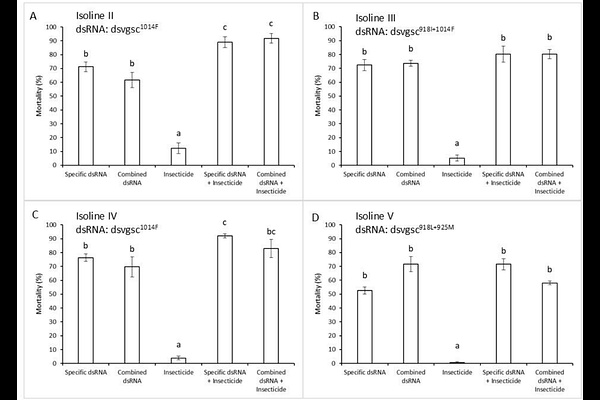
AbstractBACKGROUNDThe soybean aphid, Aphis glycines Matsumura (Hemiptera: Aphididae), is a pest of soybean in North America that can cause significant yield loss when outbreaks are not managed. Current management tactics primarily rely on inexpensive pyrethroids, but the sustainability of this option is threatened by insecticide-resistance in A. glycines populations across the Upper-Midwest United States. Field-evolved resistance is associated with mutations in the voltage-gated sodium channel subunit h1 (vgsc-h1) gene. RESULTSFour double-stranded RNA (dsRNA) molecules, each matching the sequence of a vgsc-h1 transcript variant ("Specific dsRNAs"), were topically applied to aphids with a genotype carrying the corresponding allele. The mortality of pyrethroid resistant aphids exposed to a Specific dsRNA increased in a dose-dependent manner when applied alone or with a constant concentration of lambda-cyhalothrin, plateauing at 1000 ng ul-1. Synergism was detected between two of four combinations of the Specific dsRNAs and lambda-cyhalothrin. These results were mirrored by the topical application of a single dsRNA with the consensus sequence of all vgsc-h1 variants ("Combined dsRNA"). Mortality was consistently higher in aphids treated with either Specific dsRNA or the Combined dsRNA, alone or with lambda-cyhalothrin, compared to insecticide alone. The number of nymphs produced per female treated with the Specific or Combined dsRNA alone decreased significantly compared to untreated controls. CONCLUSIONThis study demonstrates that the topical application of dsRNAs targeting vgsc-h1 increases the susceptibility and reduces the reproductive capacity of pyrethroid resistant soybean aphids, potentially providing a novel tool for the management of insecticide-resistant aphid populations.