Protein entanglement misfolding determines divergent fates: proteasomal degradation or persistence in near-native misfolded states

Protein entanglement misfolding determines divergent fates: proteasomal degradation or persistence in near-native misfolded states
Jiang, Y.; Jain, A.; Ghaemmaghami, S.; O'Brien, E. P.
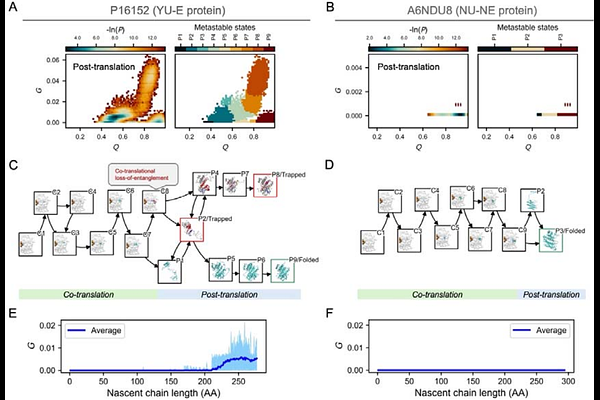
AbstractA novel class of protein misfolding, involving changes in entanglement status, occurs across the cytosolic proteome of a bacterium and likely occurs in many other organisms. Here, we examine if this class of misfolding has measurable downstream consequences for protein homeostasis. Specifically, we test the hypothesis that proteins that misfold in this way are more likely to be degraded by the ubiquitin-proteosome system immediately after synthesis. We do this by cross-referencing protein structural information with ubiquitin mass spectrometry (Ubq-MS) data from human fibroblast cells. Ubq-MS identifies proteins that have been covalently modified with ubiquitin in a particular pattern and is a cellular signal for that protein to be degraded by the proteosome. We find that nascent proteins with native entanglements, which were previously shown to be twice as likely to misfold, are 93% (95% Confidence Interval: [44%, 160%]) more likely to be tagged with ubiquitin and targeted to the proteasome compared to proteins that do not contain such entanglements. Simulating the folding of these proteins using a coarse-grained model, we find that the ubiquitin-tagged proteins containing native entanglements are four times more likely to misfold than the non-ubiquitinated proteins that are devoid of entanglements. These results indicate that entanglement misfolding, primarily involving a failure to form native entanglements, leads to an increased likelihood that those proteins will be degraded in human cells. Finally, we estimate that approximately one-third of the globular proteome likely misfolds in this way but bypasses proteasomal degradation because their misfolded states are structurally similar to their native ensemble. These consequences for protein degradation are likely common across organisms as entanglement misfolding is inherent to the polymeric nature of proteins.