A shear lag model of the podocyte foot process network predicts a mechanical feedback loop driving progressive effacement

A shear lag model of the podocyte foot process network predicts a mechanical feedback loop driving progressive effacement
Bi, M.; Jin, H.; Puapatanakul, P.; Huang, Y.; Qu, C.; Miner, J. E.; Suleiman, H.; Genin, G. M. M.
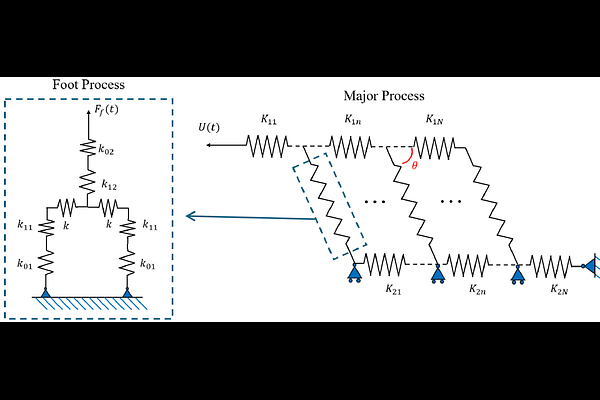
AbstractThe podocyte foot process network forms the final barrier of the kidney's glomerular filtration system. Under mechanical stress this network is prone to injury in which podocytes lose connectivity to their neighbors and begin the progression toward effacement, but what governs its mechanical resilience is unknown. We show that the network is built like a lap joint: two major processes coupled through interdigitating foot processes, a configuration that behaves as a classical shear lag system, with force concentrating at the joint ends and decaying over a characteristic transfer length set by geometry and stiffness. A discrete network model reproduces the continuum shear lag solution and identifies a hierarchy among governing parameters, with cytoskeletal stiffening of the major process amplifying foot process force more potently than basement membrane stiffness. Applying the model to morphometric data from puromycin aminonucleoside nephrosis, a model of human minimal change disease and early focal segmental glomerulosclerosis, reveals a mechanical positive feedback loop: force concentration drives foot process loss, which raises force on surviving segments and accelerates further loss. This nonlinear amplification implies a threshold beyond which failure becomes self-sustaining, analogous to the critical crack length in fracture mechanics.