Unifying Gene Regulatory Network Inference and Sequence-to-Expression Modeling via Bilinear Sparse Regression for De Novo TF-DNA Interaction Discovery

Unifying Gene Regulatory Network Inference and Sequence-to-Expression Modeling via Bilinear Sparse Regression for De Novo TF-DNA Interaction Discovery
Alonso Esteve, J.; de Ridder, D.; van Dijk, A.-J.
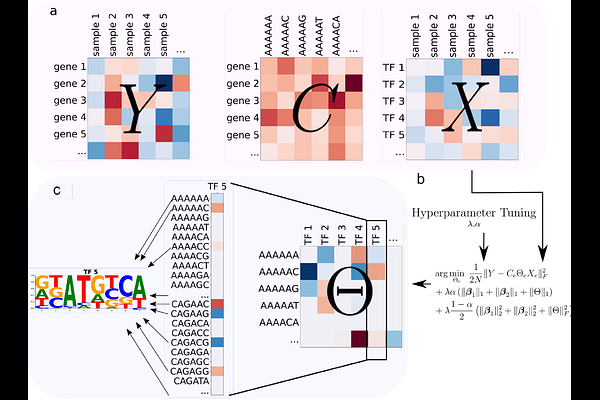
AbstractInferring transcription factor (TF)-DNA interactions from transcriptomic data is key to deciphering the genomic regulatory code. Existing computational approaches generally focus either on identifying trans-regulatory dynamics via gene regulatory network (GRN) inference or cis-regulatory sequence logic via sequence-to-expression (S2E) modeling. This requires fitting separate models across individual genes or conditions, which obscures shared regulatory structures and fails to explicitly capture cis-trans interactions.Here, we introduce BRIDGE (Bilinear Regulatory Inference from DNA and Gene Expression), a computationally efficient framework that unifies GRN inference and S2E modeling into a single, convex optimization objective. By explicitly modeling gene expression as a function of the interaction between promoter k-mers and TF abundances, BRIDGE guarantees a unique global minimimum while enabling de novo discovery of TF-specific binding motifs (TFBMs). Without the use of prior motif libraries, BRIDGE reconstructs high-fidelity TFBMs matching experimentally validated ones. Hence, we establish a new conceptual framework for linking TF abundance to cis-regulatory sequence, providing a foundation for future approaches to build upon.