Semantic fragment representations for coordinate-free analysis of genomics data

Semantic fragment representations for coordinate-free analysis of genomics data
Heydari, H.; Zhao, J.; Arseneault, M.; Younesian, L.; Tanguay, S.; Riazalhosseini, Y.; Goodarzi, H.; Najafabadi, H. S.
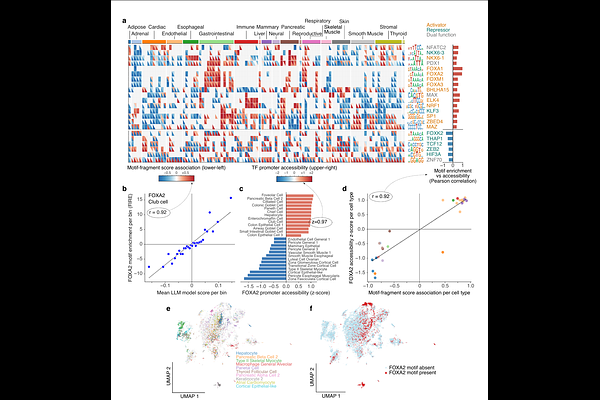
AbstractMany genomic assays begin with individual DNA fragments, but standard analysis quickly collapses those molecules into counts over genomic intervals. Rich information carried by each fragment, including its sequence, fragment body, cleavage boundaries, and local flanking context, is lost in this process. This loss is especially apparent in mixed-source and heterogeneous samples, where individual fragments originate from disparate cell types and can retain information about their cell of origin. To address this, we present LEAF-1, a fragment-level foundation model pre-trained on approximately 58 billion fragments spanning bulk ATAC-seq, single-cell ATAC-seq, and cell-free DNA profiles, representing each DNA molecule as a point in a learned semantic space defined by sequence context, assay modality, and explicit cleavage-boundary tokens. In sparse scATAC-seq datasets, mean-pooled LEAF-1 embeddings readily classify human cell types from as few as ~1,000 fragments per cell, with high-scoring fragments linked to cell-type-associated transcription-factor programs. Similarly, in cell-free DNA profiling, LEAF-1 outperformed state-of-the-art coordinate-binning strategies and general-purpose DNA language model baselines across cancer detection tasks. Applying attention-based multiple-instance learning to LEAF-1 embeddings further improved cancer detection, reaching an area under the receiver operating characteristic (ROC) curve (AUC) of 0.95. This pan-cancer model generalizes beyond cancer types it is trained on, as we show by profiling plasma samples from clear cell renal cell carcinoma patients and healthy volunteers and applying the frozen classifier without retraining, achieving an AUC of 0.83. These results show that semantic learning over individual DNA fragments preserves biochemical, cell-associated, and disease-associated signals that are otherwise lost during coordinate-based aggregation.