A Robust and Generalizable Low-Input Spatial Proteomics Workflow Enabling Deep Proteome Coverage

A Robust and Generalizable Low-Input Spatial Proteomics Workflow Enabling Deep Proteome Coverage
Courtellemont, T.; Hamelin, R.; Armand, F.; Dornier, R. J. D.; Sordet Dessimoz, J.; Pavlou, M. P.
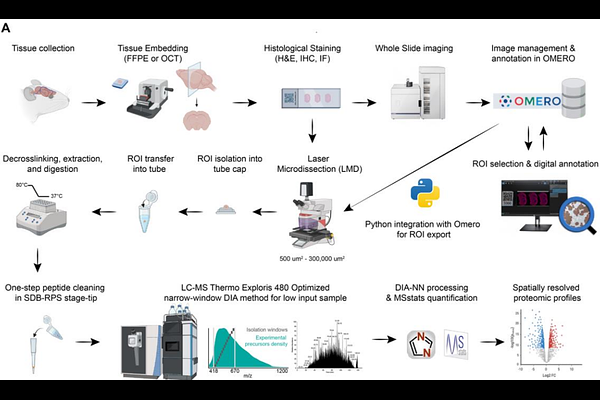
AbstractSpatial proteomics has rapidly emerged as a powerful approach for deciphering the molecular architecture of complex tissues, offering critical insights into how local proteome composition shapes tissue function. In this work, we aimed to broaden access to mass spectrometry-based spatial proteomics by putting in place a pipeline relying exclusively on instrumentation commonly available in standard histology, imaging, and proteomics facilities. The resulting workflow integrates high-resolution whole-slide imaging, image-based region selection, streamlined low-input sample processing, and a high-sensitivity method optimized on the Orbitrap Exploris platform. To demonstrate the potential of this approach, we applied it to the choroid plexus (ChP), a highly specialized but understudied brain structure whose spatial molecular organization remains poorly characterized. Analysis of ChP samples from three brain compartments across mice of different age and sex quantified more than 8,000 protein groups across the dataset from minimal input material, providing unprecedented proteome-wide resolution of ChP spatial heterogeneity. Our findings establish a foundational spatial proteomic atlas of the ChP and highlight new opportunities for investigating its roles in aging, neurological disease, and central nervous system infection.