Transcription controls chromatin-nuclear lamina contacts through distinct Lamin A and LBR tethering mechanisms

Transcription controls chromatin-nuclear lamina contacts through distinct Lamin A and LBR tethering mechanisms
Bernasconi, M.; Breda, J.; van Schaik, T.; Manjon, A.; Zambelli, F.; Pavesi, G.; Medema, R. H.; Muzi-Falconi, M.; van Steensel, B.; Manzo, S.
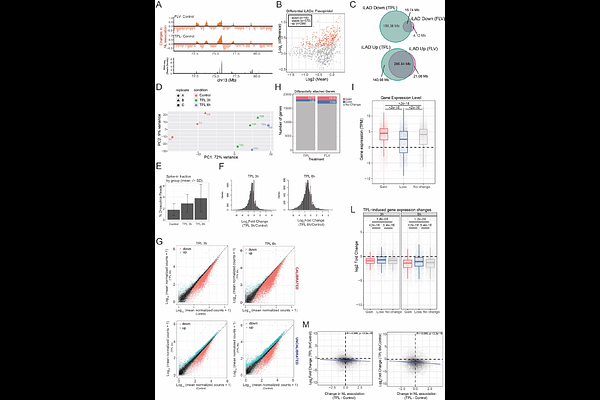
AbstractLamina-associated domains (LADs) are large genomic regions that interact with the nuclear lamina (NL). Much of the underlying grammar governing their positioning at the nuclear periphery remains unclear. LADs are composed of heterochromatin and typically harbor repressed genes, and their association with the NL is generally incompatible with strong transcriptional activity. The extent to which transcription globally shapes chromatin-NL interactions is not fully understood. Here, we combined acute transcription inhibition using Flavopiridol or Triptolide with genome-wide mapping of chromatin-NL contacts. We found that chromatin-NL interactions are rapidly rewired upon transcription inhibition. Changes in chromatin-NL contacts upon transcription shutdown are predictable based on transcriptional activity and the presence of H3K9me3-marked heterochromatin. This rewiring is reversible, as genome-NL interactions quickly return to baseline levels following drug wash-off. Notably, gain and loss of chromatin-NL interactions upon transcription shutdown reflect two distinct tethering mechanisms. Inter-LADs genomic regions (iLADs) enriched in highly active genes and located near stable LADs, which are tethered by Lamin A (LMNA/C), become re-attached to the NL following transcription inhibition. In parallel, H3K9-methylated regions tethered to the nuclear envelope by the Lamin B receptor (LBR) undergo extensive detachment from the NL. Strikingly, LMNA/C and LBR oppositely regulate transcription-sensitive LADs and are required for transcriptional control of chromatin-NL contacts. Together, our findings highlight the plasticity and dynamic nature of chromatin-NL interactions and provide the first evidence that LMNA/C- and LBR-mediated tethering mechanisms exhibit distinct sensitivities to transcription inhibition.