Systemic, RPE-directed AAV-Tyrosinase therapy restores ocular pigmentation in an OCA1 mouse model

Systemic, RPE-directed AAV-Tyrosinase therapy restores ocular pigmentation in an OCA1 mouse model
Larimer-Picciani, A. M.; Jacob, L. B.; Sullinger, K. J.; Kriebel, W. G.; Sahel, J.-A.; Byrne, L. C.
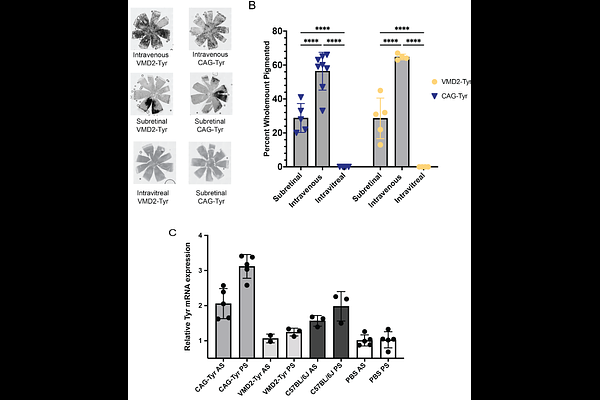
AbstractOculocutaneous albinism type 1 (OCA1) is a pigmentation disorder caused by biallelic tyrosinase (TYR) mutations, an essential enzyme for melanin synthesis. TYR inactivity results in loss of hair, skin, and eye pigment, which is detrimental for ocular function. Hypopigmentation of iris, retinal pigment epithelium (RPE), and choroid results in severe photosensitivity and low visual acuity. There are currently no FDA-approved pigment restoring therapies for OCA1, making therapeutic development an unmet clinical need. To address this gap, we have advanced an adeno-associated viral (AAV)-mediated Tyr replacement approach for OCA1 ocular pigment restoration. We evaluated the optimal viral delivery strategy and vector cell-type specificity for iris, RPE, and choroid pigmentation in an OCA1 mouse model, testing intraocular and systemic viral delivery methods in conjunction with viral constructs of varying RPE-specificity. Early, systemic delivery of an RPE-directed AAV-Tyr construct, AAV9.2yf-VMD2-Tyr, achieved widespread ocular pigment rescue with minimal off-target expression in non-ocular tissues. Animals treated with AAV9.2yf-VMD2-Tyr demonstrated reduced photophobic behavior compared to untreated controls, indicating that ocular pigmentation restores a debilitating functional consequence of OCA1. Our findings establish a foundation for clinical translation of an AAV-TYR therapy aimed at improving light sensitivity, glare, and low vision through pigment restoration in patients with OCA1.