Structure-Led Exploration of the Metagenome Yields Novel RNA-Guided Nucleases with Broad PAM Diversity

Structure-Led Exploration of the Metagenome Yields Novel RNA-Guided Nucleases with Broad PAM Diversity
de los Santos, E. L.; Rieber, L.; Wang, M.; Catherman, S.; Hatfield, S.; Bowen, T.
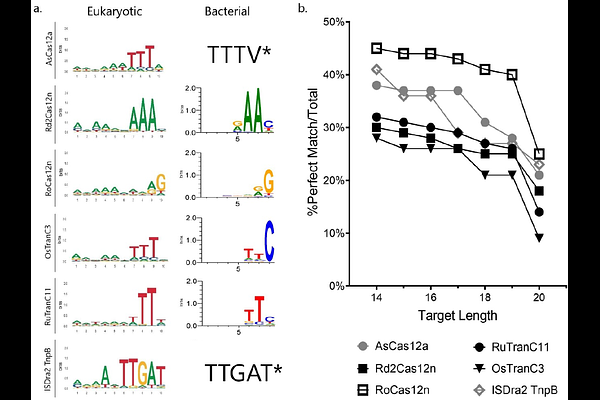
AbstractCRISPR-Cas bacterial adaptive immune systems use reprogrammable RNA guide sequences to specifically bind and cleave nucleic acids, which have been repurposed for easy and relatively efficient genomic editing. Despite its widespread use in biomedical research, the large size of Cas9 hinders AAV-mediated therapeutic delivery. Smaller RNA-guided nucleases could improve AAV gene therapy delivery, but their application is limited by their rarity among bacterial genomes and the restrictive sequence preferences of known systems, especially compared to the diversity of PAMs seen in the highly abundant Cas9 systems. Existing methods for identification of novel CRISPR subtypes rely on sequencing ever more bacterial genomes and comparing sequence homology. Using recent advances in protein structure prediction and comparison, we have identified and characterized proteins from known and novel compact RNA guided nucleases and demonstrated that their PAM preference diversity meets or exceeds that of Cas9 systems or the compact IscB and TnpB systems. This discovery has enabled us to demonstrate editing in eukaryotic cells with multiple novel subtypes, which-together with their compact size, varied PAM sequences, and high specificity-make them attractive tools for in vivo genome editing