The Potential Effect of Vitamin D Supplement on Selected Coagulability Predictors in Vape-Exposed Female Rats

The Potential Effect of Vitamin D Supplement on Selected Coagulability Predictors in Vape-Exposed Female Rats
Hammad, A. M.; Abu Samak, M.; Abu Farha, R.; Alzaghari, L. F.; Alqudah, A.; Malaeb, D.; Shnewer, K. R.; Hallit, S.; Barakat, M.
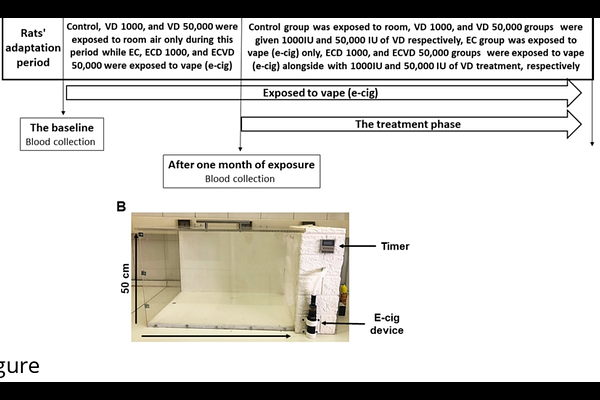
AbstractBackground: Vaping and vitamin D deficiency impact blood coagulation and health. This study aimed to investigate the effects of vitamin D supplementation on coagulation predictors in female rats exposed to E-cigarette vaping. Objective: To examine the effect of vaping alone and vaping with different VD doses on some coagulation predictors, lungs, liver, and kidney functions. Methods: Forty-two female Wistar rats were divided into six groups, including vaping and non-vaping with high (50,000 IU) and low (1000 IU) vitamin D doses. Blood samples and histopathological analyses were conducted after one and three months. Nicotine, cotinine, Interleukin-6 (IL-6), D-dimer, coagulation factor X (FX), thrombomodulin (TM), Alanine Transaminase (ALT), and Creatinine levels were analyzed. Additionally, histopathological analyses were conducted on the rats' liver, kidney, and lung. Results: Exposing rats to vaping for one month caused a significant acute increase in D-dimer, FX, and TM levels to 4402.05 ng/mL {+/-} 785.15, 1.8687 g/mL {+/-} 0.3132, and 34.71 ng/mL {+/-} 8.42, respectively. However, after three months of exposure, those levels decreased significantly compared to the one-month levels. Supplementation of the vape-exposed rats with a high vitamin D dose reduced levels of IL-6, D-dimer, FX, and TM levels to become 93.285 pg/mL {+/-} 12.715, 439.95 ng/mL {+/-} 294.05, 0.647 g/mL, and 17.375 ng/mL {+/-} 3.895, respectively, at the end of the three months. Moreover, vaping rats supplemented with the low and high doses of vitamin D had significantly lower nicotine and cotinine levels than the EC group, with a p-value of <0.0001. The histopathological examination revealed that the rats lung had necrotic pneumonia when exposed to vaping without vitamin D treatment. Moreover, all vaping groups had an alveolar hemorrhage. Bacterial pneumonia was seen in the high-dose vitamin D vape-exposed group. However, the histopathological examination of the liver indicated no major differences between the groups. One month of vaping raised D-dimer, FX, and TM levels, which decreased after three months. High-dose vitamin D supplementation reduced IL-6, D-dimer, and FX levels while increasing TM levels after three months. Vaping rats receiving vitamin D had lower nicotine and cotinine levels. Histopathological findings showed necrotic pneumonia and alveolar hemorrhage in vaping rats, with bacterial pneumonia in the high-dose group. Conclusion: Vaping activates inflammatory and coagulation pathways, while high-dose vitamin D appears to mitigate inflammation and blood coagulation issues associated with vaping, potentially aiding in reducing nicotine dependence.