A generalizable codesigned platform for solid-state nanopore sensing beyond the capacitive-noise constraints

A generalizable codesigned platform for solid-state nanopore sensing beyond the capacitive-noise constraints
Cai, N.; Guo, W.; Teng, Y.; Lou, Y.; Wong, S.-H.; Naidu, A. S.; Cona, F.; Thei, F.; Chen, T.-H.; Bastings, M.; Radenovic, A.
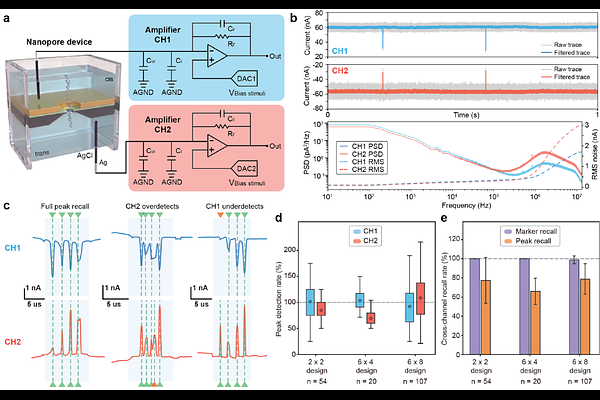
AbstractSolid-state nanopores offer label-free, real-time single-molecule sensing. However, resolving fast biomolecular transport requires high-bandwidth data acquisition while the intrinsic high-frequency noise limits recovery of informative events. Here we present a hardware-software co-designed nanopore sensing platform that combines wafer-scale low-noise device engineering with deep learning-based signal reconstruction. A low-dielectric SU8 coating on silicon nitride nanopores reduces device capacitance to the pF range and suppresses high-frequency noise by up to 5-fold while maintaining facile, controllable and reproducible fabrication. This extends usable acquisition to 40 MHz and enables capture of fast molecular features. Coupled with a reconstruction model trained on synthetic translocation events embedded in experimentally measured noise, the platform recovers transient sublevels while preserving blockage edges and temporal fidelity. Using engineered DNA molecules carrying dumbbell-like barcodes, we resolve nanometer-scale structural spacings on sub-microsecond timescales, and experimentally quantify translocation dynamics within the sub-10 nanometer regime. Dual-channel measurement on a single nanopore device further demonstrates transferability of the platform by showing robust cross-channel signal reconstruction across distinct baseline noise levels. Our approach provides a general route for reliable recovery of fast event features and may enable more information-rich single-molecule sensing across diverse biomolecular targets.