Clinical evidence yield as a framework for evaluating computational predictors and multiplexed assays of variant effect

Clinical evidence yield as a framework for evaluating computational predictors and multiplexed assays of variant effect
Shang, Y.; Badonyi, M.; Marsh, J. A.
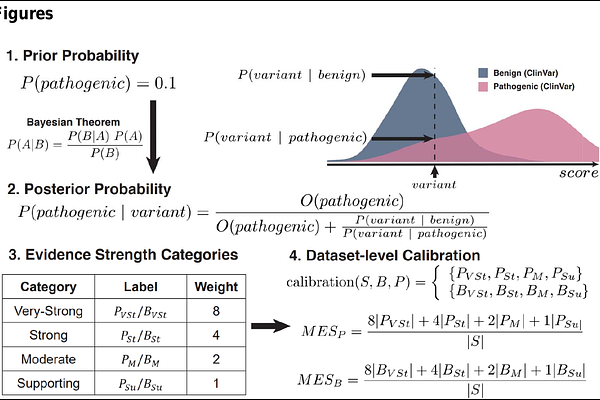
AbstractInterpreting the clinical significance of missense variants of uncertain significance (VUS) remains a major challenge in clinical genetics. Although computational variant effect predictors (VEPs) and multiplexed assays of variant effect (MAVEs) can generate large-scale functional scores, their value is typically assessed using discrimination metrics such as AUROC rather than by the strength of evidence they provide under ACMG/AMP guidelines. Here, we introduce mean evidence strength (MES), a quantitative metric that summarises the pathogenic and benign evidence assigned across missense variants following gene-level Bayesian calibration. Using the acmgscaler framework, we calibrated 12 population-free VEPs across 367 disease genes and analysed 15 MAVE datasets with sufficient clinical data. MES revealed important discrepancies with AUROC, including cases where methods with similar discrimination differed substantially in evidence yield. MAVEs achieved high average MES despite lower AUROC, while several VEPs showed strong discrimination but more limited calibrated evidence. Among predictors, CPT-1 achieved the highest MES and provided moderate or stronger evidence for the largest fraction of ClinVar VUS. MES therefore provides a practical framework for evaluating computational and experimental variant effect datasets in terms of calibrated clinical evidence yield.