Altered Crosstalk of Bacterial Lipopolysaccharide with Immune Cells in Colorectal Cancer Compared to Paired Adjacent Intestinal Tissue

Altered Crosstalk of Bacterial Lipopolysaccharide with Immune Cells in Colorectal Cancer Compared to Paired Adjacent Intestinal Tissue
Walberg, A.; Reuss, A. M.; Ziadlou, R.; Mamie, C.; Gottier, C.; White, A.; Ameri, M.; Brueggen, M.-C.; Turina, M.; Ramser, M.; Wawrzyniak, P.; Walker, M.; Truscello, L.; Aguzzi, A.; Mueller, A.; Hubeli, B.; Morsy, Y.; Scharl, M.
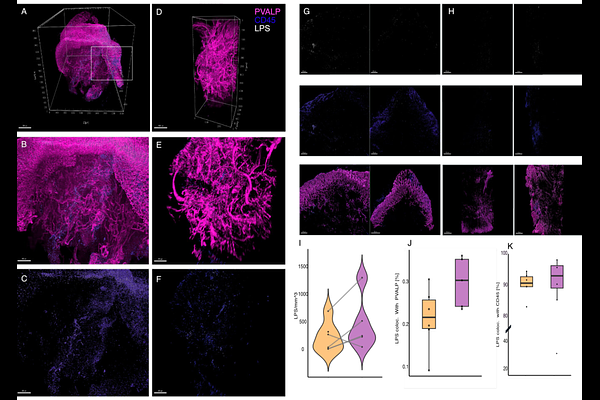
AbstractCommensal bacteria play a crucial role in modulating human immune responses in the intestine. Under homeostatic conditions, gut microbiota are tightly regulated by interactions with the mucosal immune system. However, colorectal cancer (CRC) is characterized by an imbalance in bacterial composition and bacterial translocation across the intestinal barrier. The spatial distribution of bacteria and their interactions with immune cells in CRC tumors are poorly understood. By applying 3D light-sheet imaging, spatial transcriptomics, and imaging mass cytometry to patient-derived CRC and adjacent tissue, bacterial lipopolysaccharide (LPS) is visualized alongside immune cells and vessels. The results show regional bacterial LPS accumulation and colocalization with distinct immune cell subsets. In CRC-adjacent tissue, bacterial LPS is mainly associated with CD11c+ dendritic cells, CD15+ neutrophils, and CD163+ macrophages. In matched CRC tissue, the number and LPS colocalization of CD163+ macrophages and CD11c+ dendritic cells decreased, while CD15+ neutrophils and their colocalization with LPS increased. Notably, immune cell composition and immune cell-bacteria interactions differ between tumor and adjacent tissue, offering insights into host-microbiota dynamics and mechanistic interactions.