Acute Degradation of Pumilio Proteins Uncovers a Biphasic Post-transcriptional Regulatory Hierarchy Controlling Embryonic Stem Cell Fate Decisions

Acute Degradation of Pumilio Proteins Uncovers a Biphasic Post-transcriptional Regulatory Hierarchy Controlling Embryonic Stem Cell Fate Decisions
Huang, Y.; Li, W.; Richman, H. E.; Liu, Y.; Lin, H.
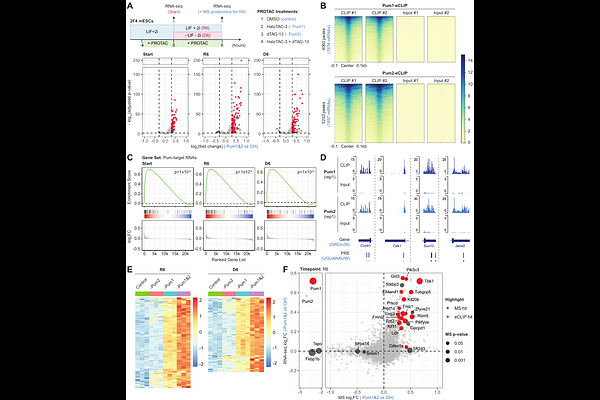
AbstractPost-transcriptional regulation is critical for mammalian embryogenesis yet has been underexplored. We previously showed that RNA-binding Pumilio proteins (Pum1/2) are essential for early mouse embryogenesis and embryonic stem cell (ESC) functions. Here, using acute protein degradation systems combined with time-resolved RNA-seq and eCLIP, we delineate a two-phase regulatory hierarchy modulated by Pum1/2 in mouse ESCs. The first phase, occurring within 10 hours of Pum1/2 depletion, is predominantly the stabilization of over 100 Pum1/2-target mRNAs, while the second phase, occurring in subsequent 66 hours, propagates to over 1,000 mRNAs mostly through indirect regulatory effects. Functionally, Pum1/2 depletion delays transition from naive to formative pluripotency, impairs neuroectoderm differentiation, and enhances germline specification. Mechanistically, Pum1/2 directly repress mRNAs encoding PRC2 subunits, including Suz12, thereby constraining H3K27me3 deposition at neuroectodermal gene loci. These findings establish Pum1/2 as biphasic post-transcriptional regulators of pluripotency and lineage balance and link RNA stability control to chromatin-mediated silencing.